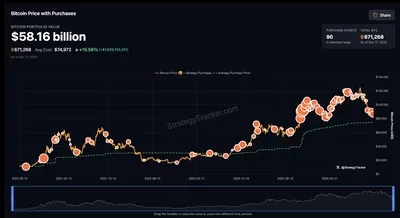
Strategy remains the largest corporate holder of bitcoin with 712,647 BTC under its control, and recent market moves have put that position back into the spotlight. After trading fell below $76K on some exchanges, observers noted the price sat near the company’s reported average acquisition level, prompting renewed speculation about a possible liquidation of part of the stash. Michael Saylor has repeatedly stated he would not sell any bitcoin, but company leaders have also outlined the narrow circumstances under which selling could occur.
Strategy's Bitcoin Holdings Under Scrutiny
At the centre of the discussion is Strategy’s size: 712,647 BTC, which makes it the biggest corporate treasury holder of bitcoin. The company disclosed a recent purchase on January 26, and that figure is now referenced in comparisons to the current market price and the company’s stated average acquisition cost. For historical context on Strategy’s holdings and past disclosures, see the earlier report on 671,268 BTC.
Speculation About Potential Bitcoin Sale
Social media chatter intensified when BTC slipped below $76K on some platforms, with users debating whether Strategy might liquidate part of its position. Michael Saylor has publicly insisted the company would not sell its bitcoin, a stance he has repeated multiple times. At the same time, CEO Phong Le has described a conditional scenario in which the company could consider selling: specifically, if Strategy struggles to raise new capital through equity or debt and its market value drops below the price of its BTC reserves.
Market Impact and Psychological Factors
Strategy has prepared to meet obligations without turning to its bitcoin holdings by increasing its so-called "green dot" reserves to over $2 billion, a buffer meant to reduce the need to sell. Observers note that the greater risk from any sale might be psychological—eroding trust in bitcoin’s institutional safe-haven story—rather than the immediate mechanical impact on supply. Prediction markets currently assign about a 5% probability that Strategy would sell before March 2026, suggesting most traders expect the company to hold.
Key Questions Addressed
Why is Strategy under scrutiny after the price drop?
Scrutiny stems from the price dipping beneath $76K on some exchanges, a level reported near Strategy’s average acquisition cost. That coincidence raised questions about whether the company’s balance-sheet position could force a rethink of its public "never sell" stance, even though leadership emphasises contingency plans to avoid that outcome.
What exact conditions might trigger a sale?
According to CEO Phong Le, a sale could be considered if Strategy cannot raise additional capital through equity or debt and if the company’s market value falls below the valuation of its bitcoin reserves. This represents a specific, finance-driven condition rather than an immediate operational decision tied to short-term price moves.
How do Strategy’s reserves affect market perception?
By increasing its USD liquidity buffer to roughly $2.19B, Strategy aims to meet obligations without liquidating bitcoin, which should lower the near-term probability of sale and reassure investors. Nonetheless, analysts and market participants remain attentive to the psychological effects that any sale announcement could have on confidence in institutional bitcoin holdings.
Почему это важно
Для майнера в России, даже с несколькими сотнями устройств, новость важна скорее психологически, чем практически: крупный корпоративный продавец принимающий решение о ликвидации может усилить краткосрочные колебания цены. При этом сами факты — что компания заявляет о нежелании продавать и что у неё есть $2.19B резервов — указывают, что немедленной принудительной продажи маловероятно.
Что делать?
- Проверить свой буфер ликвидности: убедитесь, что у вас есть резерв на оплату электроэнергии и обслуживания на случай волатильности.
- Не принимать решения только по громким заголовкам: следите за официальными заявлениями Strategy и комментариями руководства, а не за слухами в соцсетях.
- Рассмотреть хеджирование краткосрочных рисков, если у вас высокая экспозиция и ограниченный запас наличности.