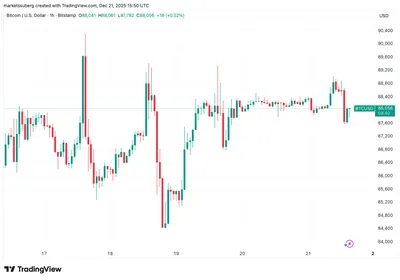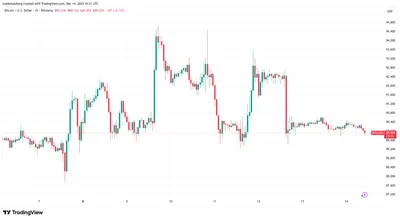
Prediction markets currently assign low odds to a quick return of Bitcoin (BTC) to six figures. Markets show a less than 10% chance that BTC will retake $100,000 before Feb. 1, 2026, with Polymarket pricing about 6% odds of crossing $100,000 before Jan. 31 and Kalshi at 7% for the same window. At the start of 2026 Bitcoin’s high sits at $97,900, reached on Jan. 14, and the BTC/USD pair was last above $100,000 on Nov. 13, 2025.
Bitcoin's Struggle to Reach $100K in Early 2026
Across short-term contracts, most bettors do not expect a swift return above $100,000, which explains the under-10% probability for the period ending Feb. 1. These market prices reflect current sentiment rather than on-chain or macro drivers, and they can change quickly as new information arrives. For a deeper look at what would be required to force a breakout to six figures, see breakout to $100K.
Trader Predictions for Bitcoin in 2026
Prediction markets offer differing timeframes for a sustained move above $100,000: Kalshi traders put a 65% chance on BTC breaking $100,000 before June 2026. At the same time, some markets expect a pullback before any retest of six figures; Polymarket traders assign 65% odds that BTC will fall to $80,000 first and then return to $100,000 later in 2026.
Other contract prices suggest deeper lows are considered possible this year: Kalshi bettors price a 54% chance that Bitcoin will bottom at $70,000 in 2026. These varied probabilities together sketch a market that sees both meaningful downside scenarios and a path back to six figures over a longer horizon.
Bitcoin's Potential Drop Below Strategy’s Cost Basis
Prediction markets also weigh how BTC might perform relative to large holders’ cost bases. Polymarket sets a 75% chance that Bitcoin will trade below Strategy’s average BTC cost price of $75,979 during 2026, while odds for Strategy selling remain below 26%. Additionally, Polymarket prices routine Strategy purchases and an 84% probability that it will hold over $800,000 BTC by the end of 2026.
Those market views come alongside recent disclosed purchases: Strategy expanded its Bitcoin treasury to 709,715 BTC after buying 22,305 coins for roughly $2.13 billion, a fact that market participants are factoring into odds and positioning. For context on how prediction markets track these developments, see prediction markets.
Why this matters
For a miner, short-term price probabilities influence revenue expectations and risk planning, because realized BTC price affects fiat income and decisions about holding or selling mined coins. Even if markets currently give low odds to an immediate move above $100,000, the same markets also show a significant chance of notable pullbacks, which can change mining economics via reduced payouts in fiat terms.
At the same time, large holders’ buying and selling intentions—reflected in these markets—can affect liquidity and volatility. Knowing how markets price those scenarios helps you decide whether to convert coin to cash, hold for appreciation, or adjust operating plans in response to price swings.
What to do?
- Monitor market-implied odds and price levels regularly, focusing on short windows (e.g., end of January) and medium-term probabilities (e.g., before June).
- Compare expected prices to your cost structure: calculate breakeven electricity and hardware costs, and consider stress scenarios that markets price (for example, a drop toward $80,000 or $70,000).
- Keep a liquidity buffer to cover operating costs through potential drawdowns so you can avoid forced sales during low-price periods.
- Decide a holding vs. selling policy in advance: set clear rules for when to convert mined BTC to fiat versus when to add to treasury holdings.
- Watch large-holder behavior and disclosed purchases, since routine buys or sells by major holders can alter short-term market dynamics and your cash-flow planning.