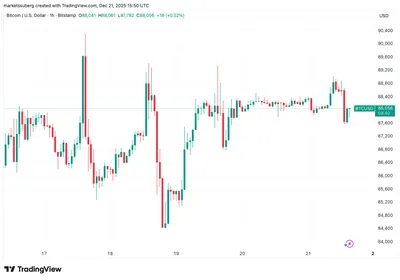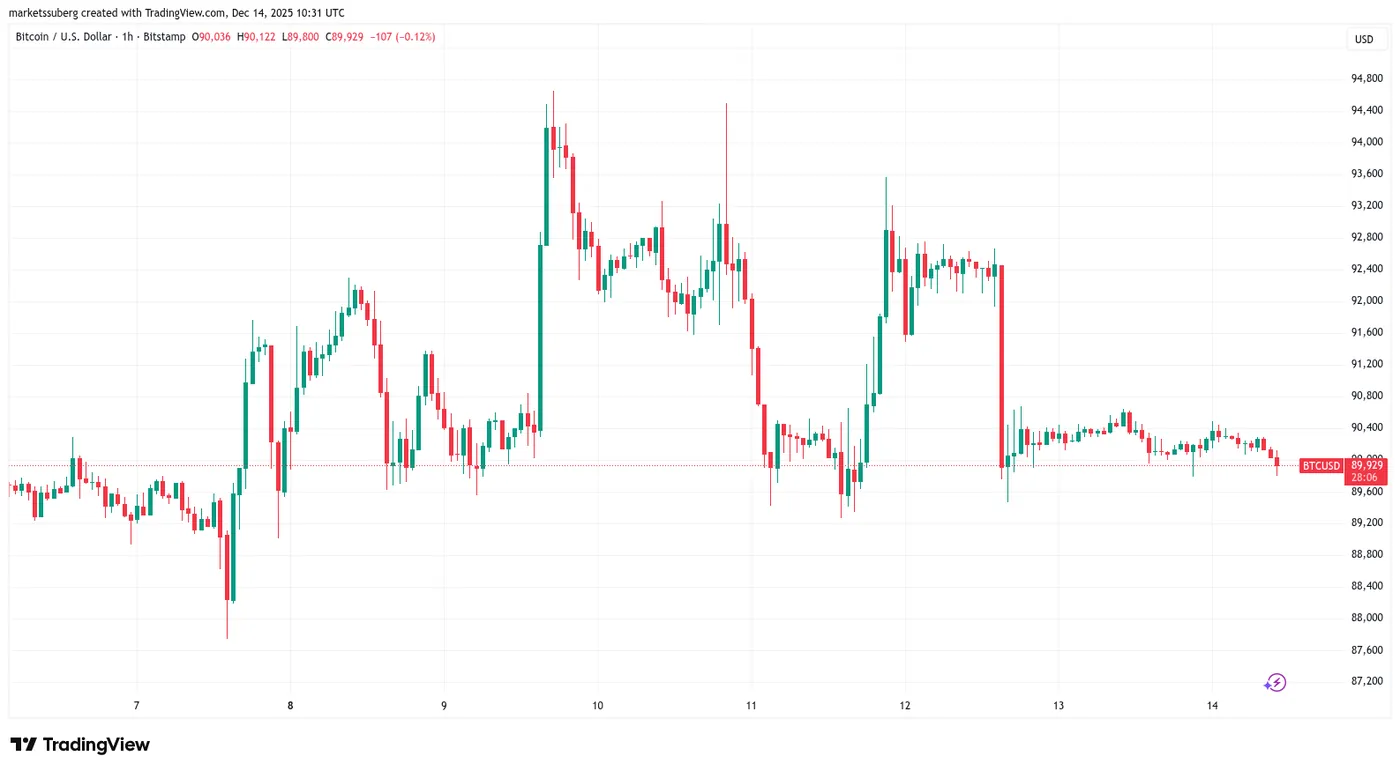
Bitcoin is holding its price within a tight corridor around $90,000, with volatility reaching "extremely low" levels, and traders are anticipating a significant move. The limited fluctuations observed in recent days have led analysts and platforms to conclude that the market is poised for a breakout in one of two directions. Both upward scenarios and potential deep corrections are being discussed, including mentions of the $50,000 level as a possible downside target.
Current Bitcoin Volatility Situation
Market data shows flat price movement over the short term and strong horizontal resistance levels above, resulting in a very narrow trading range. Trader Crypto Tony defined this corridor as $90,600–$89,800, confirming price compression within a tight interval. According to several analysts, such a low volatility regime usually precedes a directional move—up or down—depending on the strength of buyers and sellers.
Analysts' Forecasts for December 2025
Axel Kibar described the current situation as "extreme low volatility" and highlighted two possible scenarios: a breakout upward to $95,000 or continuation of a bearish reversal in the form of a "bear flag," followed by a drop into the $73,700–$76,500 zone. Meanwhile, onchain platform CryptoQuant warned that the bear market is already underway, and author Pelin Ay noted that the price is trading below key trend lines with attempts to rise accompanied by weak buying volume. For a detailed analysis of expectations and risks, see the materials on Bitcoin market expectations and risks.
Key Support and Resistance Levels
In the near term, traders highlight several technically significant levels that will influence the price direction. Important benchmarks include recovery levels, potential breakout zones, and points where a breakdown could trigger strong sell-offs.
- Current narrow trading corridor: $90,600–$89,800 (Crypto Tony).
- Levels for potential growth noted by analysts: $92,000–$94,000.
- Critical downside levels: breaking $88,000–$89,000 may increase selling pressure with a possible move toward the $85,000 area.
- The discussion also includes a deeper support target—$50,000—as a potential lower test if the bearish trend develops.
Market Outlook and Risks
The combination of descending moving averages and trading below key trend lines is interpreted by some analysts as a sign of seller dominance and buyer weakness. This reinforces warnings that the current low volatility phase could end with a sharp downward move if sellers take control. As a result, the market remains sensitive to any large order pressure and changes in trading volume.
Why This Matters
Even for miners, a period of relative "quiet" in the market is significant: sharp price moves impact income in fiat terms and the profitability of operations given current electricity rates. Low volatility does not eliminate the risk of a sudden price drop, which could reduce payouts in rubles and extend equipment payback time. Therefore, understanding key levels and analyst signals helps respond promptly to market changes and plan operational expenses.
What to Do?
Whether you operate one or up to a thousand devices, practical steps can reduce operational risks and prepare for possible price shocks. Below is a list of specific actions that can be taken without making investment decisions.
- Check and optimize miner settings and cooling systems to minimize downtime risk and improve energy efficiency.
- Monitor payout balances in the pool and fees, and regularly record revenue in rubles to assess profitability.
- Set up price and volume alerts on exchanges and monitoring services to react quickly to sharp movements.
- Maintain a cash or fiat reserve to cover expenses during short-term price drops.
FAQ
What does "extreme low volatility" mean and why is it important? It refers to a state where price fluctuations are greatly reduced and the market trades within a narrow range. Such compression often precedes a strong directional move, so traders and miners watch for breakout signals.
What is a "bear flag" and how does it affect the price? A "bear flag" is a technical pattern where a short consolidation phase follows an initial drop; if confirmed, it can lead to a renewed decline to lower levels. In the discussed scenario, this could result in prices falling to the $73,700–$76,500 range.
How can a miner know what to change in operations? Start by assessing current profitability: check energy consumption, temperature conditions, and pool payouts. If profitability declines, priorities should be reducing electricity costs and maintaining stable equipment operation.