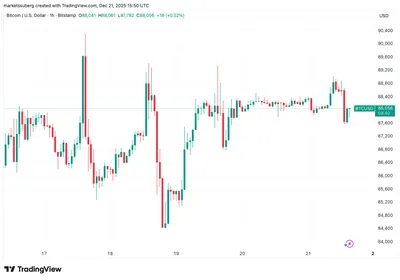
Bitcoin slipped below $87,000 on Sunday, January 25, 2026, and printed an intraday low of $86,117. Prediction markets collected around that move and now offer a mixed picture: traders show long-term optimism while near-term contracts reflect caution and tight ranges.
Bitcoin Price Drops Below $87K
The market move under $87,000 underlines the immediate pressure on price during late-January trading, with the session low reaching $86,117. That intraday dip frames how short-dated prediction markets are pricing near-term outcomes.
Prediction Markets Overview
Across Kalshi, Polymarket and Myriad Markets, the message is layered rather than uniform: longer-dated bets skew bullish, but shorter-dated contracts favor consolidation. In other words, participants are expressing directional confidence for the future while remaining guarded about timing.
Long-Term Optimism
A Myriad Markets contract that asks whether bitcoin will hit $100,000 before $69,000 shows a clear bullish tilt — traders assigned a 67.3% probability to the $100,000 outcome and 32.7% to $69,000. Because that contract resolves only when one level is touched, it reads as a vote on direction rather than timing.
Short-Term Caution
Near-term contracts tell a different story. A Kalshi contract tracking whether bitcoin will trade above $86,750 at 5 p.m. EST on Jan. 30 assigns roughly a 53% probability to the bullish outcome, indicating sentiment is almost evenly split. Polymarket’s short-dated contract for Jan. 26 reinforces the restraint: its highest-probability outcome (43%) places bitcoin in the $86,000–$88,000 band, with secondary probabilities for adjacent $2,000 ranges.
January Price Outlook
Looking across January, Polymarket’s month-wide contract centers its strongest probability around $85,000, at roughly 69% implied odds, and the market has drawn more than $61 million in volume. Collectively, these prices suggest traders expect January to cap below six figures rather than deliver a breakout.
Market Sentiment
Taken together, the markets paint a picture of patience: traders appear pragmatic and unwilling to pay up for immediate moves, yet they retain bullish expectations over a longer horizon. For now, prediction markets point toward digestion and rangebound trading rather than abrupt swings.
Why this matters
If you run from one to a thousand mining devices in Russia, short-term rangebound trading in the mid-$80,000s means daily revenue per BTC mined will likely move within a narrow band. That reduces the chance of sudden windfalls or rapid collapses in short windows, so operational decisions tied to immediate price spikes are less likely to pay off.
What to do?
- Monitor your break-even: keep track of electricity and pool fees and compare them to current BTC prices so you know when mining is profitable day-to-day.
- Plan cash flow conservatively: with markets favoring consolidation, avoid relying on short-term price jumps to cover large expenses or replacements.
- Stagger maintenance and upgrades: schedule work during expected low-volatility periods to avoid missing higher-price windows, and preserve uptime when prices are stable.
- Use simple hedges only if you understand them: if you consider selling futures or using exchanges, start small and prefer instruments you already know how to settle.
For additional context on how prediction markets have behaved recently, see a previous prediction markets in December roundup and an overview of Bitcoin price expectations. If you follow derivatives positioning, this piece on derivatives positioning may also be relevant.
FAQ
What do prediction markets suggest about bitcoin’s near-term price? They point to tight, rangebound trading in the mid-$80,000s rather than sharp moves.
Are traders still bullish on bitcoin long term? Yes, longer-dated markets strongly favor bitcoin eventually reaching $100,000.
Is a major January rally likely, according to markets? No, January-wide contracts show low odds for prices above six figures.
Do prediction markets expect a sharp crash? Not really; downside scenarios below the low-$80,000s carry relatively low probabilities according to the contracts referenced.