The Ethereum Foundation has formed a dedicated post-quantum security team, a move announced on Jan. 23, 2026, as the project shifts from long-term research toward active implementation. The effort is organized to address growing concerns about how quantum computing could threaten existing cryptographic standards across blockchain networks. At the center of the work is a team led by Thomas Coratger, with engineering efforts focused on leanVM as a foundation for a post-quantum transition.
Ethereum Foundation Launches Post-Quantum Security Team
The initiative signals a transition from exploratory research to coordinated execution across research, engineering and community outreach. Leadership by Thomas Coratger aims to unite developer teams and client implementers around concrete testing and transition plans. Weekly coordination and developer sessions are part of the operational approach to reduce the risk of user-facing disruptions during the transition.
Funding and Research Initiatives
The Ethereum Foundation has committed at least $2 million toward research grants, prizes and testing intended to achieve quantum resistance without network downtime or loss of funds. That funding includes a $1 million prize specifically to harden the Poseidon hash function and another $1 million to support broader post-quantum cryptography work, with emphasis on hash-based systems and zero-knowledge STARKs. These targeted incentives are meant to accelerate practical, testable solutions rather than purely theoretical results.
Technical Challenges and Solutions
A primary technical concern is the vulnerability of the Elliptic Curve Digital Signature Algorithm (ECDSA), which currently secures most blockchain wallets. To respond, engineering support is focused on leanVM, a cryptographic framework intended as a foundation for Ethereum’s post-quantum transition. On the testing side, multi-client development networks involving Lighthouse, Grandine and Prysm are already running to validate interoperability under post-quantum assumptions.
Community and Industry Response
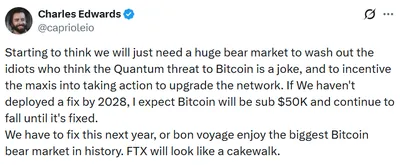
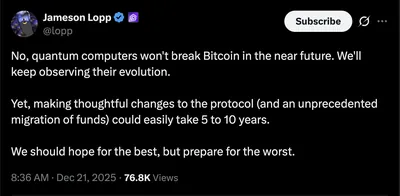
The Foundation pairs engineering work with community outreach, including workshops and published educational materials aimed at developers and institutions evaluating long-term cryptographic risk. Ethereum’s coordinated, centrally funded approach is being contrasted with other networks’ responses; for coverage of how Bitcoin and others are preparing, see Bitcoin's reaction and broader reporting on quantum risks in 2026. Coinbases's recent formation of a QC advisory task force is one example of industry-level attention to the issue.
Почему это важно
Если вы майните и храните средства на адресах, подписанных ECDSA, уязвимость этой схемы делает проблему релевантной в долгосрочной перспективе. Действия Ethereum означают, что разработчики и клиентские команды готовят план перехода заранее, что снижает риск форс-мажорных изменений в будущем. Для российских майнеров это важный сигнал: крупные сети планируют и тестируют переход, а не будут решать проблему в экстренном режиме.
Что делать?
Короткие и практичные шаги помогут удержать риск под контролем, даже если немедленных изменений не требуется. Следите за официальными публикациями проекта и тестовыми сетями, и по возможности применяйте надёжные практики управления ключами. Ниже — конкретные рекомендации, которые полезно выполнить сейчас.
- Проверьте и обновите резервное копирование приватных ключей и seed-фраз; убедитесь в надёжном хранении и доступе.
- Минимизируйте хранение крупных сумм на адресах, где вы контролируете приватные ключи, и используйте многоподпись там, где это возможно.
- Подписывайтесь на обновления Ethereum и следите за публикацией официального переходного плана на pq.ethereum.org.
- Если вы используете клиентские сборки, проверяйте совместимость с тестовыми сетями, где отрабатывают пост-квантовые изменения.