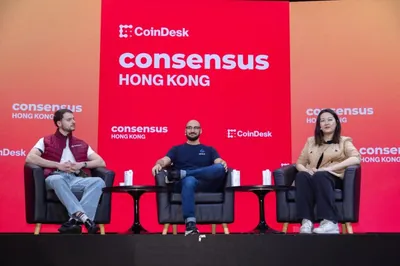
In a CoinDesk interview, Ethereum Foundation co-executive director Hsiao‑Wei Wang said the protocol is steadily shifting toward a future where zero-knowledge cryptography becomes a core part of the network itself. Wang, who was one of the key developers in designing the Merge, pointed to many breakthroughs in the past one to two years and described zero-knowledge as part of Ethereum’s midterm roadmap. She noted that more immediate upgrades focus on execution and blob space for layer-2s, while zero-knowledge is becoming increasingly feasible as a protocol-level feature. Wang will also be speaking at CoinDesk’s Consensus Hong Kong conference next month, highlighting the technology’s prominence in current discussions.
Ethereum's Zero-Knowledge Future
Wang framed zero-knowledge as a direction coming out of years of research that are now converging with concrete technical progress. That view builds on her background as a key Merge developer and on recent work inside the Foundation and research community focused on integrating zero-knowledge more deeply into the stack. For context on organizational changes related to leadership and roadmap, see Wang's appointment for the new phase at the Foundation.
Zero-Knowledge Rollups Explained
Zero-knowledge rollups first appeared in the ecosystem around 2021 as an alternative way to transact faster and more cheaply than on Ethereum’s main network. These rollups bundle transactions off-chain and submit cryptographic proofs back to Ethereum, which lets users benefit from lower fees while still inheriting the network’s security. Because rollups already use zero-knowledge proofs in this off-chain pattern, they have been the practical entry point for the technology across applications and layer-2s.
Protocol-Level Zero-Knowledge Integration
Bringing zero-knowledge directly into Ethereum’s core would change the dynamic by letting the network verify compact mathematical proofs that confirm blocks were computed correctly. That capability could dramatically reduce the work required to secure Ethereum and make it easier to scale without sacrificing decentralization or reliability. Wang described this possibility as increasingly feasible, driven by the recent wave of technical breakthroughs mentioned earlier.
Native zkEVM and Ethereum's Core Values
Ethereum researchers have published plans for a native zkEVM that would allow the network to verify transactions using zero-knowledge proofs by default. A native zkEVM would shift verification from layer-2 rollups into protocol-level primitives, altering how scaling and security trade-offs are handled. For readers interested in how zkEVMs relate to mining and scaling, see the piece on PeerDAS and zkEVMs and their effect on network scaling.
Why this matters
Protocol-level zero-knowledge changes how Ethereum proves correctness: instead of relying mainly on full execution traces, the network could accept compact proofs that a block was computed correctly, which in turn reduces the verification workload. In practical terms for the network, that shift can ease scaling pressures while preserving the security, censorship resistance and neutrality that Wang emphasized as central to Ethereum’s values. Even though rollups already provide many benefits today, integrating zero-knowledge into the core could alter long-term system design and operational demands.
What to do?
- Follow core research and talks: watch Wang’s CoinDesk interview and her session at Consensus Hong Kong to learn about roadmap signals and technical priorities.
- Keep node and client software updated: maintain compatibility with protocol upgrades and layer-2 changes so devices stay operational if verification methods evolve.
- Track zkEVM development: monitor native zkEVM plans and tooling to understand potential impacts on transaction verification and downstream services you use.
- Plan capacity conservatively: while rollups remain dominant today, be prepared for gradual shifts in verification workloads if protocol-level proofs are adopted.
- Stay informed about layer-2s: continue using rollups that offer lower fees and inherited security, since they represent the practical current path for zero-knowledge benefits.