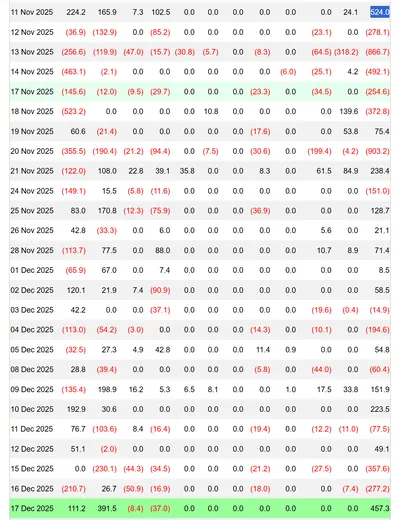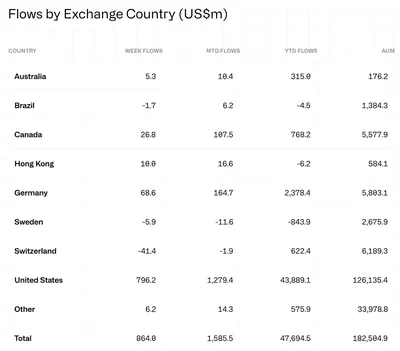
US-based spot Bitcoin and Ether exchange-traded funds began 2026 with a notable combined net inflow of around $646 million on the first trading day. Spot Bitcoin ETFs accounted for $471.3 million of that total, while spot Ether ETFs added $174.5 million, according to Farside data. These inflows arrived even as broader market indicators showed caution among investors.
Record Inflows for Bitcoin and Ether ETFs on First Trading Day of 2026
The combined inflow of roughly $646 million marks a strong opening to the year for the two ETF categories. Bitcoin ETFs contributed $471.3 million, and Ether ETFs contributed $174.5 million, together bringing total flows to $645.8–$646 million depending on the data snapshot. This surge stands out against recent trading patterns for both ETF types.
Largest Net Inflows in Recent Trading Days
For spot Bitcoin ETFs, the inflow represented the largest single-day net addition in 35 trading days, a stretch that reached back to Nov. 11. Spot Ether ETFs saw their biggest one-day inflow in 15 trading days, the largest since Dec. 9, underscoring that both asset-backed ETF categories experienced their most significant single-day moves in weeks. Such relative peaks are notable given the quieter flows seen in late 2025.
Market Sentiment and Recent Trends
Prices for Bitcoin and Ether were down modestly over the prior 30-day window, and broader sentiment measures remained cautious. The Crypto Fear & Greed Index returned to "Extreme Fear" with a score of 25, reflecting heightened risk aversion among some market participants. Bitcoin’s previous record high of $125,100 on Oct. 5, 2025 is part of the backdrop to recent volatility, but flows into ETFs continued despite the cautious mood.
Institutional Investors' Activity
Some market commentators pointed to institutional re-entry into ETFs, with claims that investors who sold Bitcoin for tax-loss harvesting in Q4 2025 have begun buying back into spot Bitcoin ETFs. One such public comment came from Tonso's chief marketing officer, who said institutional buyers were "loading up" on Bitcoin ETFs. The reopening of demand in ETFs follows a year in which US spot Bitcoin ETFs accumulated sizable net inflows overall.
For additional context on recent inflow episodes and related fund moves, see earlier coverage of large ETF inflows, such as Investments in crypto and reporting on Spot Bitcoin ETF inflows, which document similar investor interest in the recent past.
Annual Performance of Crypto ETFs in 2025
Over the full year of 2025, US investors poured over $31.77 billion into US crypto ETFs, with US spot Bitcoin ETFs taking the largest share at $21.4 billion in net inflows. That annual total was lower than the previous year's net inflows, illustrating that 2025 saw strong interest but at a different pace than the prior year. ETF flows in 2025 remain an important part of how mainstream investors accessed crypto exposure.
Why this matters
If you run mining equipment in Russia, these ETF inflows are primarily a sign of financial demand rather than a direct operational change. ETF buying doesn't change how your rigs perform, but it can influence broader market liquidity and investor attention, which in turn can affect short-term price swings for mined coins. At the same time, a return of institutional interest in ETF products can affect market narratives even when on-the-ground mining conditions stay the same.
For small and medium miners, the most immediate impact is likely indirect: stronger ETF inflows can coincide with increased volatility as traders reposition, while continued cautious sentiment on indicators like the Fear & Greed Index may keep price movements muted. Keep in mind that ETF flows and mining economics operate on different timescales; one does not automatically change your electricity costs or hardware wear.
What to do?
Operationally, prioritize stability in your setup and avoid reacting to single-day fund flows alone. Review your costs, confirm cooling and power provisions, and maintain reliable monitoring so you can respond to sustained price changes rather than day-to-day ETF movements. Solid uptime and predictable expenses matter more to profitability than short-term market headlines.
- Monitor your break-even price and power expenses weekly to spot sustained trends rather than one-day noise.
- Keep firmware and pool settings up to date, and verify remote access so you can act quickly if prolonged price moves require adjustments.
- Consider financial decisions—like selling coin holdings or reallocating proceeds—only after observing multi-day market direction and your own cashflow needs.
Finally, stay informed about ETF flows and market sentiment as one of several inputs to your strategy, but base operational choices on measurable metrics from your farm. Short-term fund inflows can be informative for timing and sentiment, yet they do not replace sound maintenance, cost control, and longer-term planning.