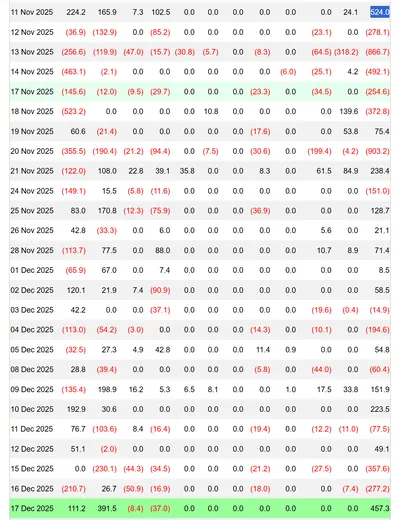
U.S.-listed spot Ethereum exchange-traded funds recorded a net inflow of $173.8 million on January 2, 2025, marking a clear move back into these regulated products. The single‑day inflow reversed the net outflows that dominated the final weeks of 2024 and was reported in fund flow data tied to the market’s ETF landscape.
Overview of Ethereum ETF Inflow on January 2, 2025
The $173.8 million net new capital into spot Ethereum ETFs represents a notable change in investor behaviour after year‑end reductions in allocations. This development arrives after the U.S. Securities and Exchange Commission approved spot Ethereum ETFs in 2024, creating a regulated channel for institutional and retail exposure to Ether without direct custody.
Breakdown of Capital Allocation Across ETF Issuers
Fund-level data shows the inflows were distributed across several major issuers rather than concentrated in a single fund, indicating broad buying interest. Below is the published allocation for January 2:
- Grayscale Ethereum Trust (ETHE): $53.69 million
- Grayscale Ethereum Mini Trust: $50.03 million
- BlackRock iShares Ethereum Trust (ETHA): $46.55 million
- Bitwise Ethereum Strategy ETF (ETHW): $18.99 million
- VanEck Ethereum Strategy ETF (ETHV): $4.56 million
The spread of inflows—from large incumbents to newer, lower‑fee products—suggests demand from both traditional and cost‑sensitive investors. For context on ETF flow dynamics in related markets, see the report on Bitcoin ETF inflows.
Context and Market Implications
The January 2 inflow contrasts with the net outflows seen in late December 2024, a period that market participants attributed to portfolio rebalancing and tax‑loss harvesting. Some observers have labelled the uptick a potential early‑year rebound, reflecting repositioning after year‑end selling pressure.
Market commentary also linked the timing to ongoing conversations about Ethereum’s protocol developments and decentralized finance use cases, which may be influencing allocation decisions. For more on recent ETH fund flow trends, readers can compare this movement with reported ETH ETF outflows from the prior period.
Expert Analysis on Institutional Sentiment
Analysts tracking fund flows note that a single day of inflows is encouraging but that sustained momentum will be the key indicator of lasting institutional interest. Reports from market‑structure observers pointed out that the narrowing performance gap between spot and futures‑based products, along with lower fee options, may be helping attract capital into spot ETFs.
Regulatory and Market Impact of Spot Ethereum ETFs
The SEC’s 2024 approval of spot Ethereum ETFs created a regulated, familiar vehicle for investors who prefer not to manage wallets or private keys. That structural change has made fund flows a clearer, real‑time gauge of institutional and sophisticated retail sentiment toward Ether.
When ETFs see inflows, issuers typically buy underlying Ether to back new shares, which can add buy‑side pressure in the spot market. The January 2 inflow therefore has implications for liquidity and price discovery, even if its longer‑term impact depends on whether inflows continue.
Why this matters (for a miner in Russia)
If you operate mining hardware in Russia—whether one rig or several hundred—the ETF inflow is an indicator of demand on the investment side of the market rather than a direct change to mining mechanics. Large inflows can increase buying pressure for Ether, which may influence short‑term price moves that affect the fiat value of mined ETH.
At the same time, ETF flows do not change network fundamentals such as block rewards or difficulty; their primary effect is on market liquidity and trader sentiment. For miners, that means ETF activity is another market signal to watch alongside on‑chain metrics and operational costs.
What to do? Practical steps for miners
Below are concise actions to consider if you mine Ethereum in Russia and want to factor ETF flows into operational decisions. These steps are practical and do not require institutional‑level capacity.
- Monitor price and flow updates: check daily ETF flow reports and price movements to understand short‑term selling or buying pressure.
- Track operational costs: compare expected revenue in fiat against electricity and maintenance expenses to decide on run‑time.
- Plan short‑term liquidity: consider when to convert ETH to fiat versus holding, based on your cash‑flow needs and recent market signals.
- Maintain equipment and backups: ensure uptime and protect payouts by keeping firmware, pools, and wallet access current.
- Keep records: log mined amounts and trades for accounting and any compliance needs without assuming specific tax treatments.
FAQ
What does a “net inflow” mean for an Ethereum ETF? A net inflow occurs when new money invested into an ETF through share creations exceeds withdrawals through redemptions on a given day, indicating net buying demand for the fund. How do inflows affect ETH price? When issuers buy Ether to back newly created ETF shares, that purchasing activity can create upward pressure on the spot market. Why is January 2 notable? That day’s $173.8 million inflow reversed the net outflows of late December 2024 and reflects renewed capital moving into spot Ethereum ETFs.