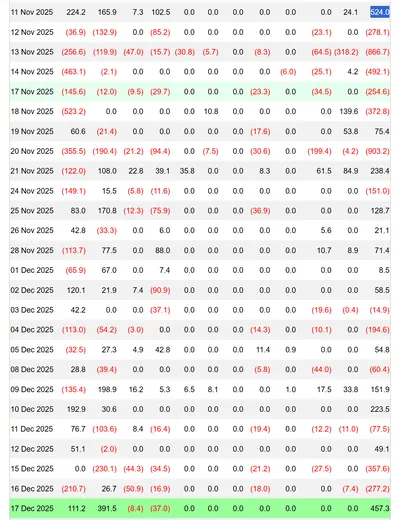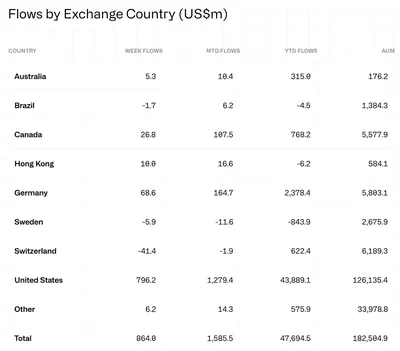
U.S. spot Ethereum exchange-traded funds recorded a $67.84 million net inflow on December 30, 2024, reversing a four-day run of net outflows. The move concentrated in a few large funds led by Grayscale’s products and supported by Fidelity’s FETH, providing a clear one-day shift in institutional flows.
ETH ETF Inflows Surge on December 30, 2024
The single-day net inflow amounted to $67.84 million and marked the first net-positive day for spot ETH ETFs since December 25, breaking the preceding four-day withdrawal trend. Grayscale’s Ethereum Trust (ETHE) was the main contributor with $50.19 million, followed by Grayscale’s Ethereum Mini ETF at $13.95 million and Fidelity’s Wise Origin Ethereum Fund (FETH) with $3.7 million.
This capital rotation represents a concentrated allocation into a few products rather than a broad-based retail rush, which helps explain why one issuer can noticeably move daily flow totals. For more on the recent withdrawal patterns that preceded this reversal, see the piece on continued outflows from ETH ETFs.
Grayscale and Fidelity Lead the Inflow
Grayscale’s ETHE accounted for the largest share of the day’s inflows, contributing $50.19 million to the total, while Grayscale’s Mini ETF added $13.95 million. Fidelity’s FETH supplemented the day’s buying with $3.7 million, making these three vehicles the primary drivers of the observed net inflow.
The concentration of flows in familiar, liquid funds likely reflects issuers’ brand recognition and existing institutional relationships, factors that can influence where large buyers place capital within a short time window.
Mechanics of Spot ETH ETF Flows
Spot Ethereum ETFs hold the underlying ETH. When investors buy shares, ETF issuers use the invested cash to purchase an equivalent amount of ETH, which custodians then hold on behalf of the fund. This mechanism creates direct market demand for Ethereum when inflows occur and direct selling pressure when shares are redeemed.
Because the ETFs transact in the underlying asset, daily net inflows and outflows provide a transparent measure of buying and selling pressure from a specific institutional channel, making these figures useful for assessing immediate demand dynamics.
Expert Analysis on Flow Reversals
Analysts often view a reversal following several days of outflows as a possible sign of consolidation, where earlier sellers are absorbed by fresh buyers and a short-term support may form. The dominance of a single issuer in flow data can also reflect liquidity preferences or institutional mandates rather than fee considerations alone.
Year-end portfolio actions, such as rebalancing or position adjustments, are a common explanation for concentrated flows at month-end and can influence one-off inflow figures without implying a permanent change in trend.
Comparative Context and Market Impact
Compared with spot Bitcoin ETFs, which have seen larger single-day inflows since their launch, the Ethereum ETF market is operating at a smaller absolute scale. A $67.84 million day is meaningful within the current size of the ETH ETF complex and is closely watched as an indicator of institutional engagement.
For perspective on flows in other crypto ETF markets, including the larger spot Bitcoin inflows earlier in the year, see our coverage of Spot Bitcoin inflows.
Why this matters
If you run one device or a rack of miners in Russia, ETF flows matter because spot ETF inflows translate into real buy orders for ETH, which can support market price pressure in the short term. Even a single-day reversal shows active institutional participation, which is one of many factors that affect liquidity and trading conditions.
At the same time, a one-day inflow does not by itself establish a long-term trend, so miners should treat it as a data point rather than a signal to change long-term operational plans.
What to do?
Monitor price and volume but avoid reacting solely to a single day of ETF flows: track a few consecutive days to see if the pattern holds. Keep an eye on custody and withdrawal procedures for any ETH you sell off, and make sure your bookkeeping and tax records reflect trades accurately.
Operationally, focus on mining efficiency and cost control—flows can influence price volatility, but your margins depend on power costs, hash rate, and equipment uptime. For broader flow dynamics and recent withdrawal episodes, you can review the summary of weekly outflows.