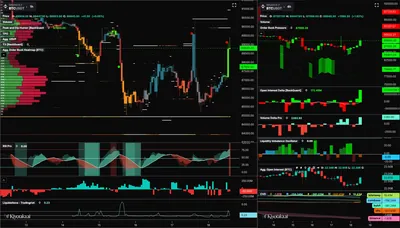
On January 10, 2026 Bitcoin entered a period of stagnant consolidation, remaining close to the $90,500 level as momentum from earlier in the month faded. The session began with a brief uptick — BTC opened slightly above $91,000 — but no fresh catalysts emerged to sustain a move higher. By midday EST trading volume had fallen sharply to $20 billion, roughly half of its recent weekly average, underscoring the muted conviction behind current price action.
Bitcoin Price Consolidation on January 10, 2026
Throughout the day BTC oscillated in a narrow band, effectively hovering near the $90,500 mark and showing little directional bias. That tight range reflected market participants’ reluctance to commit large positions while the broader context remained unclear. With price staying above the psychological $90,000 floor, the market looked range-bound rather than trending.
Market Stagnation and Technical Indicators
Analysts described the market as trapped in a "no-trade zone," a phrase used to reflect muted activity around the $90,000 area and limited upside conviction. Technical indicators reinforced this picture: a neutral relative strength index (RSI) of 47 paired with a slightly bearish MACD suggests the early-January momentum has dissipated into distribution. For readers who want a deeper look at resistance dynamics, see why BTC can't clear $90K, which reviews nearby technical barriers.
Impact of the U.S. Supreme Court's Tariff Ruling Delay
The consolidation followed a volatile week in which the U.S. Supreme Court’s decision to delay its ruling on President Donald Trump’s reciprocal tariffs briefly sparked a relief rally. That uptick proved short-lived: the price gained some traction after the court’s delay but then lost its upward thrust almost as quickly as it appeared. In short, the tariff-related news provided only a temporary catalyst, not a sustained driver of momentum.
Hal Finney's Iconic Tweet Anniversary
Outside the price charts, Jan. 10 marked the 17th anniversary of the first tweet to mention the cryptocurrency. The late developer Hal Finney’s two-word message — “Running bitcoin” — remains a symbolic reminder of the network’s resilience and origins. The anniversary offered the community a historical moment amid otherwise technical and liquidity-driven market conditions.
Market Structure and Analyst Insights
Market structure has shifted since December’s heavy accumulation, with exchange netflows turning positive over the past 72 hours and signs of minor distribution or de‑risking near the $90,000 level. The Enigma Trader highlighted that current inflow volumes are small relative to December’s outflows, and that a sustained green netflow environment could build sell-side pressure. For context on the recent persistence of price levels around $90K, see stuck at $90K.
Why this matters (for a miner in Russia with 1–1,000 devices)
Short-term consolidation and a sharp drop in trading volume mainly affect market liquidity and the execution price you might get if you sell BTC. Lower volume can widen spreads and make large sales move the market more than usual, which matters if you plan to convert mined coins to fiat. At the same time, technical signs of distribution and positive exchange inflows suggest market participants are taking some profits near current levels, which could pressure prices in the short term.
What to do? Practical steps for miners
- Monitor exchange netflows and on‑chain activity to time larger transfers off‑exchange; avoid big sales in low‑liquidity periods when possible.
- Stagger conversions to fiat to reduce the impact of thin order books; split any planned sell orders into smaller batches over time.
- Keep an eye on technical indicators like RSI and MACD as part of your timing decisions, but don’t rely on them alone for operational planning.
- Maintain mining hardware and pool settings to ensure consistent payouts; operational continuity matters regardless of short-term price moves.
- Factor in local electricity costs and withdrawal fees when deciding whether to hold or sell mined BTC; small margins can be decisive at current price levels.