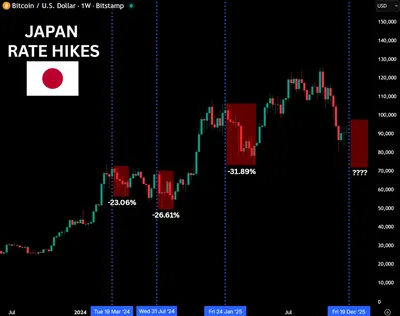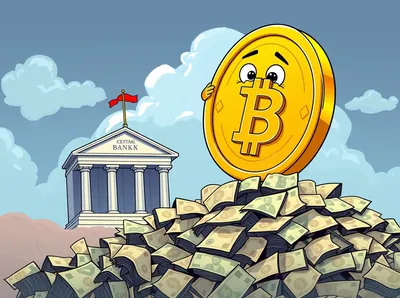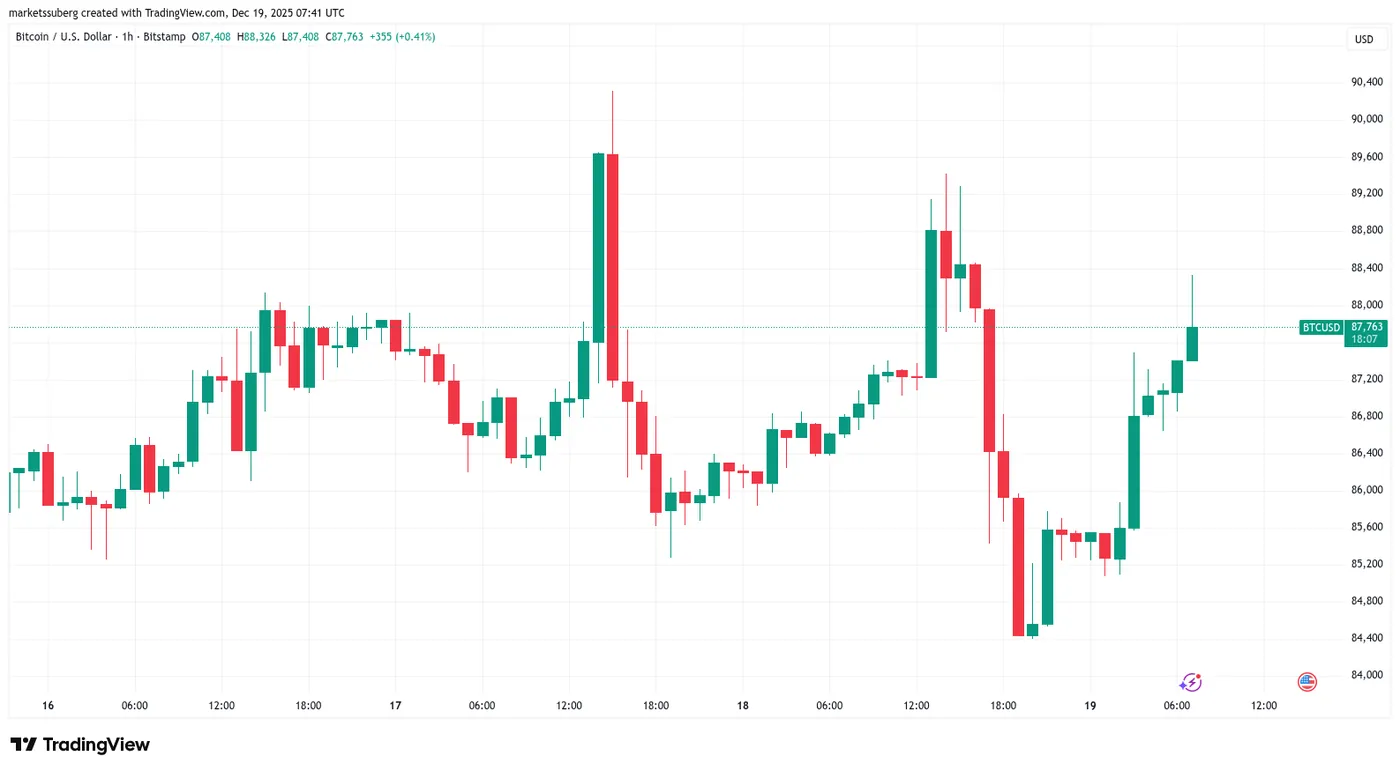
Bitcoin moved higher after the Bank of Japan raised interest rates to around 0.75%, prompting a roughly 2.5% intraday gain versus the daily open and pushing the cryptocurrency toward an $88,000 target. The move followed BoJ policy that reached its highest levels in three decades and signalled an end to the country’s most recent spell of “cheap” money, while US equity futures also reacted positively.
Bitcoin’s immediate market reaction to the BoJ rate hike
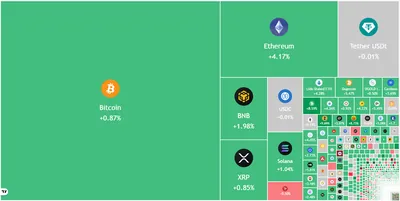
Markets reacted with a generally bullish tone: Cointelegraph Markets and TradingView data showed about 2.5% gains for BTC from the daily open, and Nasdaq 100 futures were up 1.5% as the session opened. Bitcoin’s intraday price action saw it aiming for $88,000 even as traders digested the BoJ announcement and broader volatility following surprise US inflation data.
Details of the Bank of Japan decision
The Bank of Japan raised rates to around 0.75%, a level described in coverage as the highest in three decades and one that ends the recent period of “cheap” money in Japan. Some commentators framed the move as notable against a backdrop of global central-bank easing, while others pointed to domestic constraints that could limit further tightening.
Research project Temple 8 Research argued there is a political ceiling on further hikes and predicted rates would not rise again before 2027 to protect the yen and avoid increased interest payments on Japan’s latest $140 billion stimulus package. Temple 8 also summarised the tension between fiscal support and rate increases in its blog post.
Market commentary and expert quotes
Among market voices, former BitMEX CEO Arthur Hayes said bluntly: “Don’t fight the BOJ: -ve real rates is the explicit policy.” His comment was one of several suggesting the BoJ decision could be interpreted as ultimately supportive for asset holders despite being notionally a headwind.
Trading resource Mosaic Asset Company forecast: “With participation remaining strong some measures of investor sentiment shifting back to showing fear, that’s a positive backdrop to see a rally in the final weeks of the year.” Onchain analytics platform Checkonchain warned that “Bitcoin is currently hammering out a bottom, but the process is far from over,” and singled out $81,000 as the cost basis for the US spot Bitcoin ETFs.
Price action, volatility and technical levels to watch
Volatility followed surprise US inflation data, with BTC/USD briefly hitting a low of $84,390 before the rebound. Market commentators and on‑chain analysts flagged $81,000 as an important support level tied to ETF cost basis, and social-media posts included calls for further support retests amid cautious trader positioning.
Why this matters
For a miner running from a single rig to a small farm, the BoJ decision matters mainly as background for global risk sentiment rather than a direct operational change. A central bank move that prompts rallies in risk assets can lift BTC prices, which affects revenue in fiat terms, while elevated volatility increases the chance of sharp intraday swings that affect short-term cash flow.
At the same time, the Temple 8 view that further BoJ hikes may be politically constrained until 2027 suggests the event is unlikely to trigger a prolonged period of tighter global liquidity directed at Japan alone; for miners in Russia, that means any local impact from this specific decision is likely to be modest and indirect.
What to do?
If you operate 1–1,000 devices, focus on immediate operational resilience rather than trying to trade short-term moves in BTC. Check that your mining setup has updated power and cooling plans, confirm any fiat-cost forecasts against recent price swings, and avoid overreacting to a single central-bank announcement when planning cash flows.
For risk management: (1) keep a short-term reserve to cover at least several days of expenses in case of price dips, (2) set clear rules for when to convert mined BTC to fiat based on your own cost structure, and (3) follow key technical levels such as $81,000 and recent intraday lows like $84,390 to inform but not dictate operational decisions.
This article does not contain investment advice or recommendations. Every investment and trading move involves risk, and readers should conduct their own research when making a decision.