The Bank of Japan raised its base interest rate by 0.25 percentage points to 0.75% — the highest level in nearly 30 years. According to BoJ Governor Kazuo Ueda, the decision was unanimous amid growing confidence in economic prospects. Following the announcement, the yen weakened to approximately 156 per $1. For the cryptocurrency market, this decision coincided with sharp intraday volatility in Bitcoin's price.
Event Summary
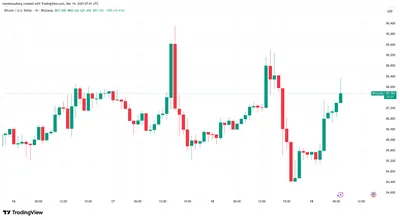
After the rate hike announcement, BTC's price initially climbed from $87,100 to $90,400, then dropped to $86,000 in less than two hours. These price swings were accompanied by mass liquidations: total position losses exceeded $500 million, with over 1951 long positions liquidated within 24 hours. Collectively, these events highlighted the market's high leverage and the scale of stress confirmed by on-chain data.
Details of Bitcoin Price Movement and Liquidations
The brief price increase from $87,100 to $90,400 was followed by a sharp drop to $86,000 in under two hours, triggering a cascade of long position closures. Estimates in the article indicate total liquidations surpassed $500 million, with over 1951 long positions liquidated in a day. On-chain data showed signs of credit stress, and high leverage amplified the price swings.
Bank of Japan's Decision and Market Reaction
The BoJ raised the rate by 0.25 percentage points to 0.75%, the highest in nearly 30 years, with the governor noting the unanimous decision. The market had partially priced in the tightening: after the announcement, the yen weakened to about 156 per $1, indicating limited surprise. For a detailed analysis of how monetary policy impacts the crypto market, see the BoJ policy impact article.
Historical Context: Previous Rate Hikes and BTC Reactions
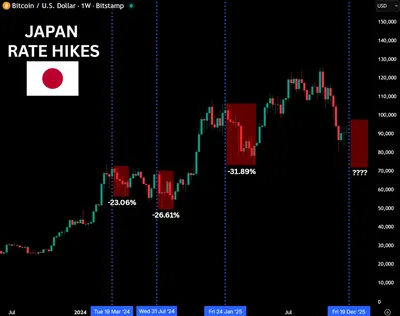
The article references past episodes of strong Bitcoin reactions to BoJ policy tightening: in July 2024, when the rate was raised to 0.25%, BTC dropped about 26%, and in January 2025, before the hike to 0.5%, the market experienced declines up to 31%. These examples serve as analogies, heightening concerns about a potential new wave of declines. For a broader risk forecast, see the material on why Bitcoin might fall, discussing scenarios of further pressure.
Terminology Explanation
- Long Liquidations — forced closure of long positions when the price moves against the trader; an increase in such liquidations intensifies sell-offs.
- On-chain data — blockchain transaction and activity data that help assess stress levels and participant behavior.
- Carry trade — strategies involving borrowing in a low-interest currency and investing in higher-yield assets; unwinding carry trade amid yen weakening can reduce global liquidity.
Consequences and Short-Term Risks
Mass liquidations, high leverage, and BoJ’s tightening policy create an unfavorable environment for the crypto market in the short term. The authors express concerns that the current cycle could trigger another wave of Bitcoin price drops of 20% or more, especially if carry trade unwinding in yen and global liquidity tightening occur. On-chain data already reflect significant stress, increasing the risk of sharp moves.
Why This Matters
If you mine in Russia with a small rig farm or manage several hundred rigs, price fluctuations and mass liquidations affect revenue and liquidity. Sharp price drops can make margin positions vulnerable, which in turn increases overall market volatility and may indirectly impact electricity prices and equipment demand. Even without a direct link between your farms and Japanese policy, overall market nervousness raises the risk of large intraday fluctuations.
What to Do?
For miners with 1–1000 devices, it’s important to focus on risk management and quick decision-making. Reduce leverage in trading and avoid margin strategies if you’re not prepared for rapid drawdowns; this lowers the risk of forced sales and capital losses.
Monitor key indicators: Long Liquidations, on-chain metrics, and the yen exchange rate, as these reflect credit stress and potential carry trade unwinding. Also, set clear stop-losses for trading positions, plan electricity expenses considering increased volatility, and maintain cash reserves for prolonged downturns.
Brief Summary
The BoJ raised the rate to 0.75%, the yen weakened to approximately 156 per $1; BTC briefly rose from $87,100 to $90,400, then dropped to $86,000, triggering over $500 million in liquidations and more than 1951 Long Liquidations. Mass liquidations and high leverage create a short-term negative outlook.