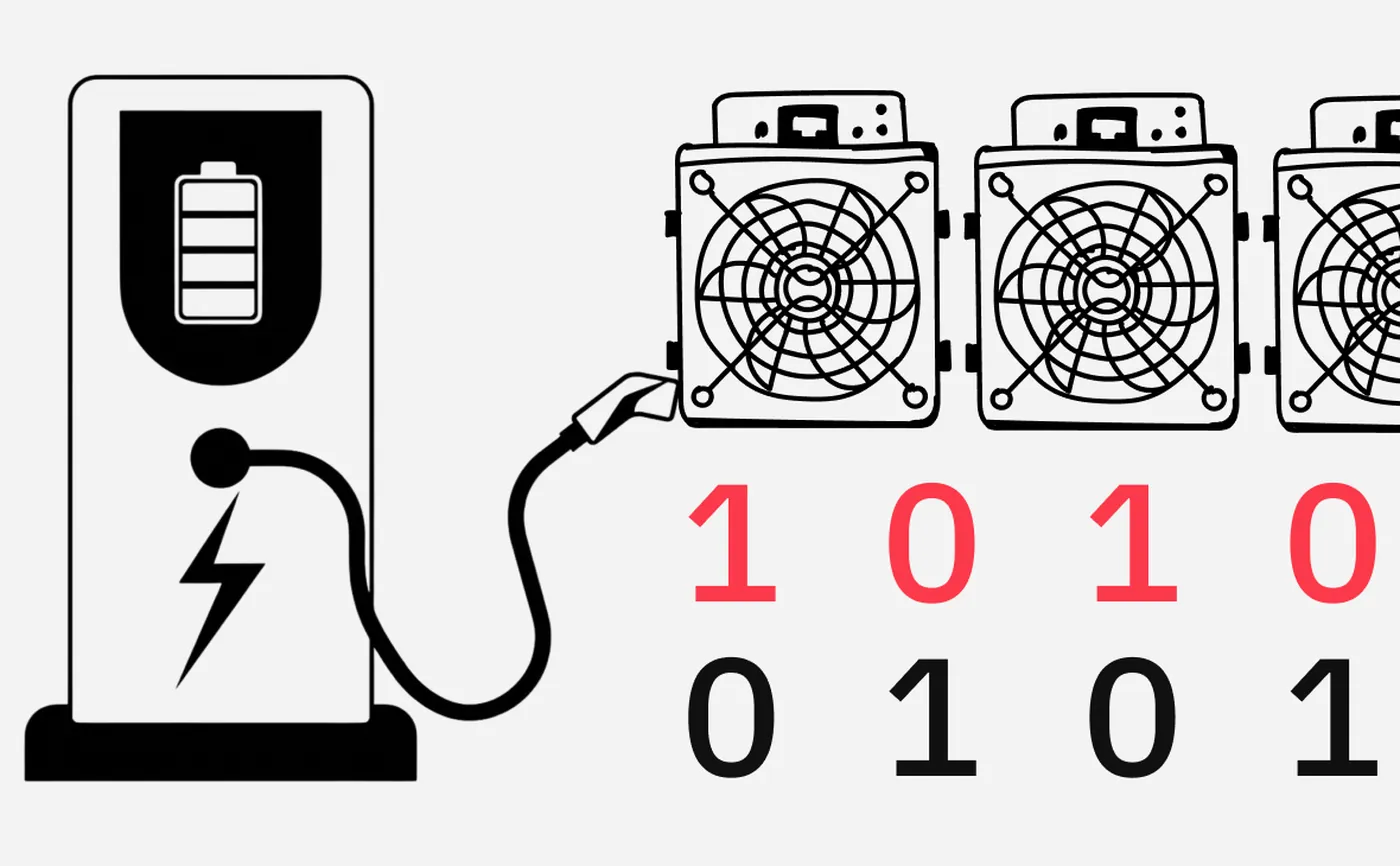
A patented EV charging station with integrated mining functionality was developed in St. Petersburg, reigniting discussions around hybrid solutions. The concept combines vehicle charging with cryptocurrency mining equipment, providing direct access to stable power supply but also raising legal and economic concerns. Experts from legal and operational firms explain under what conditions such a model can be justified and when it remains experimental.
What Is Mining at EV Charging Stations?
This refers to built-in computing modules within charging stations that mine cryptocurrency simultaneously while supplying energy to the vehicle. The developers’ idea is that the user pays for charging, while part of the power is allocated for mining—this helps utilize idle capacity and potentially generate additional income.
Similar concepts are already in use in various forms: Russia has cryptoboilers, the US features miner-heaters for private homes, and Norway uses mining heat for drying fish. These examples illustrate both residential and industrial scenarios, though not all are equally applicable under Russian conditions.
Legal Aspects of Mining in Russia
Legally, mining integrated into infrastructure is not exempt from standard requirements: the owner of such a charging station must register in the miner registry maintained by Russia’s Federal Tax Service (FNS), keep accounting records, and pay taxes. Lidings partner and ROCIT expert Dmitry Kirillov emphasizes the need for separate accounting of mining income and expenses.
According to Digital & Analogue Partners partner Yuri Brisov, the current legal framework is designed primarily for industrial mining as a main activity, not for auxiliary infrastructure functions. This creates a risk of activity reclassification and additional charges if household or preferential electricity consumption regimes are used.
Economic Feasibility of Mining at Charging Stations
Developers have presented calculations based on low tariffs, whereas the actual average price for charging an EV at network stations in Moscow is about 18–19 rubles per kWh. Experts note that when regulatory requirements and taxes are considered, savings from combining functions often do not cover additional expenses and risks.
Furthermore, lawyers and operators point out the scale problem: a single or small installation yields too little effect for stable profit but remains noticeable to energy providers and tax authorities. Under such conditions, the project may be economically inefficient.
Other Models Combining Mining with Energy Consumption
- Cryptoboilers and miner-heaters—using waste heat in residential heating systems.
- Industrial scenarios—integrating mining heat into heating or technological needs of warehouses and production facilities.
- Monetizing idle capacity—running mining on temporarily unused facility power to enable early loading and generate cash flow.
Prospects for Hybrid Mining Models in Russia
Intelion’s Commercial Director Anton Gontarev notes that the viability of hybrid models depends on the availability of surplus or temporarily unloaded capacity and proper engineering integration. In these projects, mining serves as a tool to improve efficiency rather than the primary activity.
For example, Intelion implemented a project in the Samara region where mining is used for early operational loading and enhancing economic efficiency during facility commissioning. Experts believe sustainable solutions require integration into infrastructure and transparent energy consumption accounting.
Why This Matters
If you mine at home or manage several installations, embedding mining into a charging station may seem attractive by combining functions and potential monetization. However, in Russia, such schemes fall under existing mining regulations, meaning mandatory registration, tax accounting, and commercial electricity tariffs.
For owners of one to a thousand devices, the real benefit from such integration is usually small: without large-scale engineering and accounting work, savings are almost always offset by regulatory costs and risks of additional charges. This is an important practical criterion when evaluating such solutions.
What to Do?
- Check registration requirements: before launching embedded mining, consider that the owner must be registered in the FNS miner registry and maintain separate income and expense records.
- Verify tariffs and electricity accounting: use commercial rates and document consumption to avoid risks of additional charges and fines.
- Assess scale and engineering integration: small home setups rarely yield economic benefits; consider mining as part of a large infrastructure project.
- Consult a lawyer and engineer: obtain legal and technical assessments before implementation to properly account for taxes, reporting, and energy network requirements.