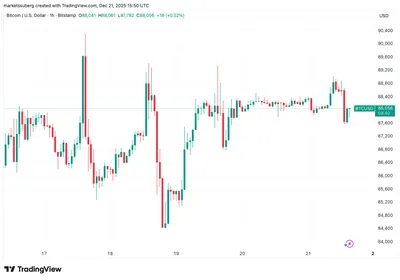
On January 13, 2026, Bitcoin moved in a narrow intraday band, trading between $91,800 and $92,479 while broader intraday swings ranged from $90,128 to $92,479. The market showed sizable depth with a market cap of $1.83 trillion and a 24-hour trading volume of $44.68 billion, signaling active participation despite the tight price action. Short-term technicals favor the bulls, yet longer-term moving averages remain tilted lower, creating a mixed-but-watchful landscape for traders.
Current Bitcoin Price Range and Market Data
Bitcoin’s primary trading window for the session was $91,800–$92,479, reflecting a compact range within which most activity occurred. Market capitalization held at $1.83 trillion, and the 24-hour trading volume registered $44.68 billion, which puts the intraday moves in the context of meaningful liquidity. Together, these figures frame the current market as concentrated but capable of a decisive move if volume shifts.
Intraday and Recent Price Movements
Intraday price pivots extended from $90,128 up to $92,479, showing that resistance levels continue to check upside attempts while buyers defend the higher band. The recent multi-week rally ran from roughly $84,000 to $94,800, a move of about 12.3%, after which the price settled into consolidation above $91,000. That consolidation looks like a pause after gains rather than a reversal, and it underpins the short-term bullish tilt as momentum reorganizes.
Technical Analysis: Charts and Indicators
The daily chart reads as sideways with a bullish undercurrent: prices have stabilized above $91,000 following the rally and are digesting gains. On the four-hour timeframe a rounded bottom from the $89,200 low suggests accumulation and coiling energy that could resolve with increased volume. Meanwhile, the hourly view shows Bitcoin boxed between $91,000 and $92,500, with several failed breakouts indicating tension at the short end of the market.
Key Support and Resistance Levels
Immediate support is located near $89,199, which has acted as a reference for recent recovery efforts. Resistance is clustered around $92,576, and the $92,500 area serves as a practical ceiling on intraday timeframes; a clean push above that level is noted as capable of testing higher zones such as $93,700–$94,000. Until a convincing breakout occurs, the range between $91,000 and $92,500 is likely to remain the focus for short-term traders.
Oscillators and Moving Averages
Oscillators—including RSI, Stochastic, CCI, and ADX—sit in neutral territory, which points to equilibrium rather than extreme readings. Momentum, the Awesome oscillator, and MACD show positive signals, aligning with short-term bullishness. From the 10- to 50-period ranges, both EMA and SMA sit below the current price, while the 100- and 200-period EMAs and SMAs remain bearish, creating the familiar clash between near-term strength and longer-term resistance.
Bullish and Bearish Outlook
The bull case highlights consolidation above $91,000, positive momentum indicators, and short-term moving averages clustered beneath price, suggesting the structure is firming for a potential upside run. Conversely, the bear case rests on subdued volume during rallies and the drag from longer-term averages; resistance at $92,500/$92,576 has proven stubborn and a drop below $90,000 would reopen the path to deeper retracement. For now, the short-term bias is slightly bullish but remains contingent on volume and a clean breakout.
Why this matters
For miners running from a single device up to larger rigs, the current tight range means predictable short-term price movement, which can simplify decisions about selling or holding mined BTC. Market cap and trading volume figures show the market has liquidity to absorb normal miner flows, but the presence of strong resistance means timing sales around breakouts or retracements matters. In short, the situation is not forcing urgent action, but it rewards attention to short-term levels and volume.
What to do?
If you mine with a small number of devices and need regular fiat, consider planning sales around clear intraday support levels and avoid selling during low-volume approaches to resistance. Larger operators should monitor the $89,199 support and the $92,500–$92,576 resistance area for signs of decisive volume; a confirmed breakout with increased volume could be a window to reduce short-term inventory. For both groups, keep an eye on short-term moving averages and oscillators rather than long-term averages when making near-term operational decisions.
For recent context on how Bitcoin traded at lower levels earlier this season, see the price today summary, and for a broader look at December movement and technical levels consult the December 2025 overview.