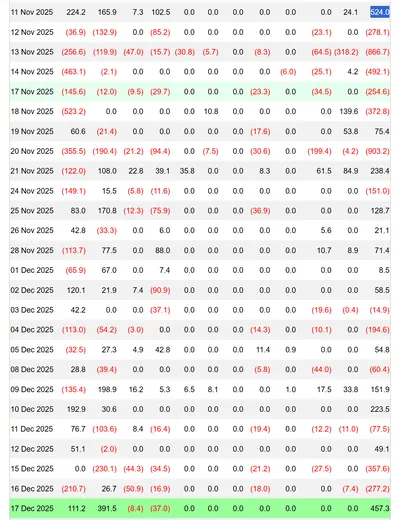
U.S. spot Bitcoin exchange-traded funds recorded a net inflow of $694.67 million on January 5, 2025, according to market data. That inflow marked a second consecutive day of positive flows and highlighted strong institutional participation in regulated Bitcoin products. The day’s allocation was concentrated among large, well-known asset managers, with other providers also seeing meaningful, if smaller, contributions.
Overview of January 5, 2025 Bitcoin ETF Inflows
The single-day net inflow totaled $694.67 million and represented a clear pulse of capital into U.S. spot Bitcoin ETFs. This movement, noted as the second straight day of positive flows, was framed in market reports as a demonstration of institutional conviction in these regulated vehicles. For additional context on recent flow patterns, see Jan 2 inflows and related coverage.
Breakdown of Inflows by ETF Provider
BlackRock’s iShares Bitcoin Trust (IBIT) led the day with an inflow of $371.89 million, while Fidelity’s Wise Origin Bitcoin Fund (FBTC) added $191.19 million. Together, those two funds accounted for over 81% of the total net inflow on January 5, 2025, underscoring the dominance of large-brand providers in new allocations.
Other funds reported additional, smaller inflows that contributed to the day’s aggregate total. Bitwise Bitcoin ETF (BITB) attracted $38.45 million, Ark Invest’s ARKB saw $36.03 million, Invesco Galaxy Bitcoin ETF (BTCO) gathered $15.02 million, and Franklin Templeton’s EZBC recorded $13.64 million. Grayscale’s Mini Bitcoin Trust moved $17.92 million, while Valkyrie’s BRRR and VanEck’s HODL had inflows of $7.19 million and $5.34 million respectively.
Context and Significance of Sustained Inflows
These consecutive positive-flow days come after the approval of U.S. spot Bitcoin ETFs in early 2024, a regulatory milestone that opened a new channel for institutional capital. Market commentary framed the sustained inflows as part of a transition from initial novelty toward ongoing demand within regulated frameworks. The January 5 data was presented as one point in a larger trend of institutional adoption and portfolio allocation to Bitcoin via ETFs.
Expert Analysis on Market Structure and Traction
Commentary on the flows highlights several recurring drivers: portfolio rebalancing at the start of the year, competition on fee structures, and the pull of brand recognition and distribution networks. Providers with scale and established distribution—such as BlackRock and Fidelity—captured the bulk of new capital even as lower-fee or niche managers also drew interest.
Analysts also point to the role of the underlying Bitcoin market: ETF inflows translate into purchases of the asset by issuers and authorized participants, which creates direct buying pressure on Bitcoin. The diversity of firms receiving inflows—from traditional asset managers to crypto-native teams—was described as evidence of a layered market structure with both high-liquidity giants and specialized options. For a broader look at flows and liquidity in 2025, see Bitcoin ETFs in 2025.
Comparative Performance and Long-Term Implications
A single-day net inflow of $694.67 million ranks among the stronger daily performances reported since spot ETFs began trading. Coverage framed the figure as indicative that these products are moving beyond an initial launch phase toward sustained, demand-driven use by investors. Over time, persistent ETF buying was described as creating a structural source of demand within regulated markets for Bitcoin.
Почему это важно
Для майнера в РФ большая институциональная активность в ETF — это дополнительный источник покупательского давления на Bitcoin, поскольку эмитенты ETF и авторизованные участники покупают базовый актив для покрытия новых выпусков. Это не даёт мгновенных гарантий по цене, но повышает ликвидность и делает рынок более связанным с традиционным финансированием.
При этом прямое влияние на повседневную работу майнера обычно ограничено: притоки в ETF не изменяют технические условия майнинга или тарифы на электропитание. Тем не менее следить за такими потоками полезно, потому что они отражают, насколько легко крупный капитал может входить и выходить с рынка.
Что делать?
Мониторьте потоки ETF и общую ликвидность рынка, чтобы понимать, как меняется баланс спроса и предложения на Bitcoin. Это поможет принимать взвешенные решения по продаже крупной доли добытого актива и планированию налоговых событий.
Оптимизируйте рабочие расходы: держите резерв средств на оплату электроэнергии и обслуживания, и следите за эффективностью оборудования. При наличии значительных объёмов BTC в обороте оценивайте варианты хранения и реализации, учитывая комиссию и скорость исполнения, а не следуя краткосрочным новостям.
Bottom line
The January 5, 2025 inflow of $694.67 million, led by BlackRock’s IBIT and Fidelity’s FBTC, represents a concentrated, institution-driven allocation into U.S. spot Bitcoin ETFs. While large managers dominated the day’s flows, a range of other providers also participated, painting a picture of tiered but broad institutional interest. Tracking these flow patterns remains a useful tool for understanding the evolving interface between traditional finance and Bitcoin.