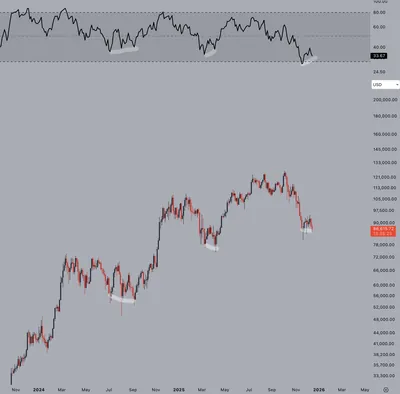
On-chain analyst Willy Woo identifies December 24, 2025 as the probable cyclical low for Bitcoin, a date that marked a visible shift in investment behavior. Since then, inflows into Bitcoin ETFs and direct wallet acquisitions have grown, reversing the outflows that dominated the previous quarter and signaling renewed demand.
Bitcoin’s December 2025 Bottom: Key Insights
Willy Woo’s assessment points to December 24, 2025 as the likely price trough based on on-chain flow metrics and miner activity. The reversal from outflows to inflows — visible in both ETFs and direct wallet purchases — suggests accumulating investor interest after the December low. These on-chain signals do not guarantee a sustained rally, but they are commonly used to identify early sentiment shifts.
For readers who want a deeper look at market-bottom indicators, see signs of a market bottom, which discusses on-chain and volume cues that often accompany cycle lows.
Mining Economics and Price Support
Data from the Cambridge Centre for Alternative Finance put the global average Bitcoin mining cost between $38,000 and $42,000 in late 2025, creating a tangible cost band for miners. When the market price fell below that range in December, mining operations representing roughly 15% of the network hash rate temporarily suspended activity, reducing immediate supply pressure.
Rather than liquidating reserves at a loss, many miners prefer to throttle or pause production until conditions improve, which can act as a short-term price support. As prices moved back above the production-cost band, some previously idled miners resumed operations, restoring hash rate and contributing to market stabilization.
Macroeconomic Influences on Bitcoin
Woo’s analysis also notes policy changes that could affect demand for alternative financial products. In particular, President Donald Trump’s executive order capping credit card interest rates at 10% is highlighted as a development that may push some consumers toward decentralized finance and cryptocurrency-based services.
Such macro moves can change credit availability and consumer choices in ways that indirectly influence crypto adoption, though the effects are distributed and not instantaneous. Miners and market participants should treat these policy shifts as one of several demand-side factors rather than a sole driver of price action.
Institutional Adoption and Regulatory Developments
Institutional participation remained a stabilizing factor during the downturn. BlackRock’s iShares Bitcoin Trust reached $25 billion in assets under management by January 2026, while Fidelity’s digital asset arm expanded its workforce by 40% in Q4 2025, indicating continued institutional commitment to crypto services.
Regulatory clarity has increased in major jurisdictions: the European Union’s MiCA framework became fully operational in December 2025, and Japan’s Financial Services Agency approved three additional cryptocurrency exchanges in November 2025, bringing the total to 48 licensed platforms. These developments strengthen the institutional infrastructure and may support longer-term engagement; for related perspectives, see the 2026 price forecast.
Why this matters (for a miner in Russia with 1–1000 devices)
If your breakeven sits near the global cost band, the December low and subsequent miner pauses show how production adjustments affect short-term supply. A temporary reduction of about 15% of global hash rate eased competition when price fell below costs, which can reduce immediate downward pressure on price and delay forced sales.
Institutional inflows into ETFs and growing regulatory clarity can improve liquidity and reduce volatility over time, but these are gradual influences rather than instant fixes. Policy changes like the credit card rate cap are discussed as possible demand drivers, yet their direct impact on a small Russian mining operation is likely indirect and slow to materialize.
What to do? (practical steps for miners)
- Compare your full production cost to the $38,000–$42,000 range and update your breakeven model to include current power and maintenance expenses.
- If operating below your breakeven, plan for staged responses: reduce hash, pause nonessential rigs, and preserve BTC reserves rather than selling at a loss.
- Maintain hardware and spare-parts stock; resuming operation quickly when prices recover reduces lost revenue during restart periods.
- Track ETF flows and regulatory news (MiCA, Japan approvals, institutional AUM) as indicators of liquidity and institutional demand that affect market depth.
- Keep accurate records for accounting and tax purposes and review local compliance requirements; regulatory shifts abroad can prompt changes at home.
Bottom line
Willy Woo’s identification of December 24, 2025 as a probable cyclical low is supported in this analysis by miner behavior and inflows into ETFs and wallets. The $38,000–$42,000 mining-cost band and the temporary 15% hash-rate pause are concrete operational facts that matter for miners assessing profitability and restart timing.
Institutional adoption and clearer regulation provide contextual support for measured recovery, but miners should prioritize cost control, operational readiness and compliance when navigating the coming months.