The U.S. regulatory environment for digital assets in 2025 remains fragmented, policy-driven, and dependent on shifting administrative priorities. Agency posture—more than single statute—continues to shape how tokens are treated across markets and services. Courts have clarified some issues around secondary-market transactions and token classifications, but the overall federal architecture is still defined largely by enforcement choices and rulemaking efforts.
SEC Enforcement in 2025
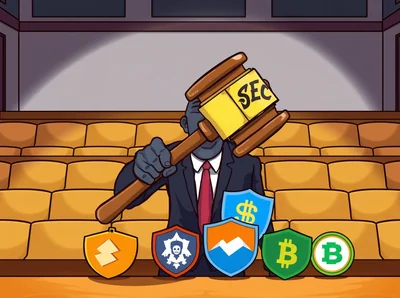
The SEC continues to exert significant influence over the digital-asset industry, though its posture has moderated from its peak enforcement years. The agency still prioritizes cases involving unregistered exchanges, staking-as-a-service platforms, token sales tied to fundraising, and airdrop-based growth campaigns, reflecting concern about intermediaries and promotional schemes rather than purely decentralized protocol activity. Senior leadership has given pro-crypto speeches and the commission created a Crypto Task Force aimed at moving from regulation-by-enforcement toward building a more comprehensive framework; notably, the SEC removed digital assets from its 2026 Examination Priorities, which signals reduced designation of the sector as a special risk area.
That softer tone is a policy choice, not a statutory guarantee, and enforcement priorities can change with administrations. For context on how the agency’s posture has shifted in recent months, see SEC pauses suits, which discusses related developments in SEC litigation strategy. Firms should therefore treat current restraint as contingent rather than permanent.
CFTC vs. SEC Jurisdiction
Dual jurisdiction is a defining feature of U.S. digital-asset regulation: the CFTC has consistently taken the position that most tokens—particularly those with decentralized or commodity-like characteristics—are commodities under the Commodity Exchange Act. The SEC, by contrast, treats many tokens as investment contracts when they are tied to issuer-driven ecosystems, fundraising, or centralized control. This split means the same token can fall under both regimes in different respects.
The overlap is especially visible in certain categories of market activity, including:
- DeFi derivatives, where automated protocols may facilitate swaps or margin-like exposures;
- Perpetual futures markets, which fall within CFTC derivatives jurisdiction but can involve tokens distributed through SEC-regulated transactions;
- Staking and validator services, which may implicate SEC investment-contract considerations alongside CFTC commodity-based service arrangements.
Because of this duality, market participants often navigate two federal regimes at once, even when statutory mandates do not neatly align. Questions about custody, control, and the economic realities of a token typically determine which agency’s rules are implicated; for related discussion on custody and control, see SEC and crypto custody.
Pending Federal Legislation
Congress continues to debate multiple digital-asset market-structure bills, including versions commonly referred to as a federal CLARITY Act. Although proposals differ, their shared aim is to reduce regulatory uncertainty by clarifying when tokens qualify as securities versus commodities and by setting registration and oversight rules for platforms and issuers. To date, none of these proposals has become law, so the federal picture remains incomplete.
- Define when a token transitions from security to commodity, giving issuers a pathway out of SEC jurisdiction once decentralization thresholds are met;
- Create a federal registration regime for "digital commodities" issuers to permit compliant offerings without defaulting to securities-law frameworks;
- Clarify exchange registration and oversight requirements to better delineate SEC and CFTC supervision.
Separately, the GENIUS Act regulates stablecoins specifically, but as of 2025 there is no unified federal framework governing digital assets generally. In practice, states continue to fill regulatory gaps through money-transmission laws, virtual-currency licensing, and consumer-protection measures, which creates a multijurisdictional compliance challenge; for implications that can affect miners in particular, consult material on tax rules for miners.
Conclusion
By late 2025 the U.S. crypto regulatory landscape is at a crossroads: the SEC’s tone has softened, the CFTC maintains a commodity-based approach, and Congress is actively debating market-structure bills though none have yet unified the field. Until legislation sets clear lines of authority and issuance pathways, regulatory uncertainty will persist and compliance will remain a moving target. Market participants should watch both agency priorities and state-level developments to manage risk effectively.
Why this matters (for a miner in Russia with 1–1000 devices)
Even if you operate from Russia, the U.S. regulatory environment affects global markets, exchanges, and service providers you may use for trading, custody, or payouts. The SEC’s continued focus on intermediaries and promotional schemes means platforms you interact with could face enforcement actions that affect access or operations, while CFTC jurisdiction over commodities can influence derivatives and trading venues your counterparties use.
State-level rules and a patchwork of federal interpretations create added friction: payment rails, exchange listings, or custodial services might change practices in response to U.S. policy, which in turn can affect liquidity and withdrawal processes. Keeping an eye on these developments helps you avoid sudden service disruptions and make informed decisions about where to trade or hold assets.
What to do?
- Monitor the policies of exchanges and custodial services you use, and keep backups for withdrawals and key management in case a provider changes terms.
- Separate operational activities: document the provenance of mined coins, track receipts from pools or exchanges, and keep clear records for tax and compliance purposes.
- Limit exposure to services that appear to offer staking-as-a-service or aggressive token promotions without clear legal frameworks, since these areas are SEC priorities.
- Prefer platforms with transparent compliance policies and where possible use counterparts that disclose how they treat tokens under SEC/CFTC frameworks.
- Follow developments in federal bills like the CLARITY proposals and stablecoin rules to anticipate changes that might affect exchange access or custody options.