The Global Initiative Against Transnational Organized Crime (GI‑TOC) released a scathing report on Dec. 17 that says the Central African Republic faces a "grave risk of state capture" through a rapid embrace of opaque crypto projects. The report links those projects to risks to national sovereignty as President Faustin‑Archange Touadéra seeks a third term in the Dec. 28 elections, and it accuses his administration of "trading away the country’s sovereignty" to insiders and shadow networks.
Key findings from the GI‑TOC report
The GI‑TOC highlights several concrete concerns about CAR’s crypto initiatives, emphasizing lack of transparency and potential elite capture. It warns that projects intended as national development tools instead benefit a narrow circle and may enable foreign criminal influence and sanctions evasion.
- The report warns of a "grave risk of state capture" and ties the timing to the Dec. 28 election.
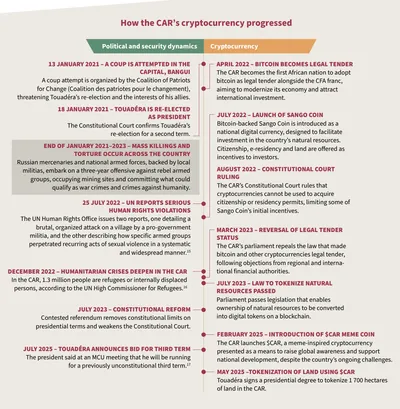
- Sango Coin was intended to fund a "Crypto City" and offer citizenship and land to foreign investors, but it "flopped," selling less than 10% of its target tokens.
- A government meme token called CAR was launched in early 2025 and used to tokenize about 1,700 hectares of land in Bosongo; these land sales are listed on the Solana blockchain and lack clear budget transparency.
Timeline and background of CAR crypto initiatives
The report traces CAR’s crypto agenda back to 2022, when the country adopted bitcoin as legal tender as part of a broader push into digital assets. Under pressure from the International Monetary Fund and regional regulators, the government later reversed the bitcoin decision and pivoted to other projects such as Sango Coin and, later, the CAR meme coin.
What happened with Sango Coin and the CAR meme coin
Sango Coin was promoted as a national cryptocurrency to finance a futuristic "Crypto City" and to attract foreign investment through offers of citizenship and land. According to the GI‑TOC, the token sale underperformed badly, with less than 10% of target tokens sold, while the follow‑on CAR token was used to tokenize roughly 1,700 hectares in Bosongo near Bangui without clear evidence that proceeds reached the national budget.
Infrastructure and inclusion constraints
Analysts cited in a Reuters report note a stark mismatch between the government’s high‑tech plans and the country’s physical infrastructure. With only 15.7% of the population connected to electricity and fewer than 40% holding mobile subscriptions, the report says meaningful participation by the country’s roughly 5.5 million citizens is effectively impossible.
Risks ahead of the Dec. 28 election
The GI‑TOC warns that extending crypto tokenization to mineral concessions — including gold, diamonds and oil — could cause a permanent loss of control over vital national resources. The report concludes these blockchain ventures may be deepening elite control at the expense of the wider population and could be attractive to transnational criminal networks seeking ways to launder money or bypass sanctions.
Reactions from Bangui
The Bangui government declined to comment on the GI‑TOC report, while a senior official speaking anonymously described the findings as an effort to "discredit" the administration. That official defended the crypto projects as necessary alternatives to the "monopoly of banks," rejecting the report’s central claims.
For readers who want related reporting on external meddling and crypto in political finance, see an investigation into foreign interference in political funding, which provides context on how digital assets can intersect with outside influence. For perspectives on regulatory and oversight concerns, review coverage of oversight risks and debate around state roles in crypto.
Why this matters (for miners and small operators)
If you run mining equipment — from a handful of devices to several hundred — this report is relevant even if you don’t operate in CAR. The findings show how quickly token projects can be promoted by states and insiders without transparent accounting, and how those projects can be used to shift control over land and resources. That matters because similar governance and transparency issues shape regulatory reactions that can affect cross‑border crypto flows and the broader reputation of digital assets.
In practical terms, limited electricity and mobile access in CAR underline that most citizens cannot participate in token sales, so these schemes are unlikely to reflect broad domestic support. The report also highlights the potential for projects tied to state agendas to become entangled with criminal networks or political disputes, which can prompt sanctions or scrutiny that ripple across the crypto ecosystem.
What to do?
If you operate mining rigs, prioritize operational resilience and legal clarity. Ensure your setup complies with local laws where you live and consider power costs and availability before expanding. Keep records of energy use and equipment purchases so you can demonstrate legitimate activity if regulators or service providers ask for documentation.
Stay informed about regulatory developments and high‑profile cases like the GI‑TOC report because they influence public narratives and policy. For further reading on how cryptocurrency projects intersect with shadow economies, see reporting on crypto in Southeast Asia’s informal markets like the shadow economy discussion.