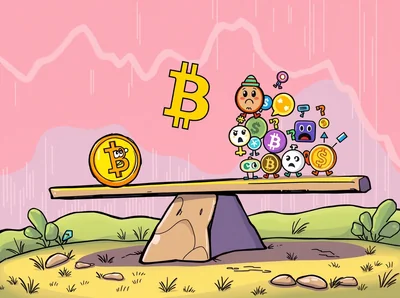
The widely followed Crypto Fear & Greed Index dropped 12 points to 49, moving investor sentiment into the neutral zone for the first time in three months. This shift occurred amid mixed economic signals and evolving regulatory developments, prompting analysts to re-evaluate near-term market dynamics. While the reading itself does not indicate a clear directional bias, it highlights a moment of market reassessment where volatility and participation metrics have changed.
Crypto Fear & Greed Index Drops to Neutral Zone
The index now sits at 49 on a scale that runs from 0 (extreme fear) to 100 (extreme greed), placing markets squarely in the midpoint. Such neutral readings are notable because they often follow periods of stronger directional sentiment and can mark consolidation phases or turning points. The recent move from a higher reading to 49 represents one of the sharper sentiment shifts recorded this year and echoes earlier regulatory-driven transitions.
Understanding the Crypto Fear & Greed Index
The index is designed to capture overall market psychology by combining multiple data sources rather than relying on a single indicator. Its multi-factor methodology aims to reflect both on-chain and off-chain signals so participants can gauge whether markets are driven by emotion or fundamentals. For background on how specific readings are interpreted, see index at 42 for a previous example of sentiment interpretation.
- Volatility — 25% (measures price swings versus 30- and 90‑day averages)
- Trading volume — 25% (current activity vs. historical norms)
- Social media sentiment — 15% (mentions and engagement)
- Survey data — 15% (retail and institutional responses)
- Bitcoin dominance — 10% (share of market cap)
- Google search trends — 10% (search volume for crypto terms)
Factors Behind the 12-Point Drop
Several measurable changes drove the index lower, led by a pronounced easing of volatility. Thirty-day volatility dropped approximately 18% compared to the previous week, indicating smaller price swings and reduced short-term uncertainty. At the same time, spot trading volume declined by 22% across major exchanges, while social media discussions about cryptocurrencies fell about 15% and Google search volume for crypto terms decreased 12% week‑over‑week.
Bitcoin’s market dominance remained relatively stable at approximately 52%, which suggests that capital did not rotate significantly between Bitcoin and altcoins during this period. The combined movement across these components produced the aggregate 12-point decline to the neutral reading.
Expert Perspectives on Neutral Sentiment
Analysts characterize neutral readings as periods when markets consolidate and reassess. Dr. Elena Rodriguez, behavioral finance researcher at Stanford University, explains: "Neutral sentiment periods often allow markets to consolidate gains, establish new support levels, and prepare for sustainable advances." Her view emphasizes slower, more deliberate market behavior during balanced sentiment.
Technical analysts add that the mid-range of the index can act as a reaccumulation band. John Chen, chief technical analyst at Digital Asset Research Group, observes: "The 45-55 range has historically served as a reaccumulation zone." Portfolio managers see selective opportunities: Michael Reynolds at Horizon Capital states: "We view neutral sentiment as an opportunity to selectively add positions in fundamentally strong projects." At the same time, risk managers warn that sentiment can turn quickly if unexpected events occur.
Historical Context and Market Implications
Historical data indicate that neutral readings between 40 and 60 often precede significant market movements, with outcomes varying by broader market conditions. In some periods, neutral sentiment has preceded continued gains as markets gather momentum; in others, it has marked temporary pauses before declines. Comparisons to prior regulatory-driven shifts underline that context matters when interpreting the index.
Broader Market and Structural Developments
The move to neutral coincides with structural improvements in market depth and ongoing institutional engagement, even as short-term participation metrics fell. Regulatory progress in some regions and technological upgrades elsewhere are occurring in parallel, which can decouple fundamental development from short-term sentiment swings. For an example of how low readings have been covered previously, see index at 20.
The European Union’s Markets in Crypto-Assets (MiCA) regulation implementation is progressing steadily, providing clearer frameworks in that jurisdiction. Separately, Ethereum’s recent protocol upgrades have improved network efficiency and reduced environmental impact, demonstrating that technical advancement continues even when sentiment is neutral.
Why this matters (for a miner in Russia)
For miners running between one and a thousand rigs, a neutral index reading typically means calmer price swings and thinner trading activity, which can reduce short-term opportunities for frequent selling. Lower volatility and reduced spot volume — reflected in the recent 18% drop in 30-day volatility and 22% decline in spot trading — make fast speculative moves less common, so miners may experience longer holding periods before price moves justify selling.
Neutral sentiment does not change underlying costs such as electricity or equipment maintenance, but it can affect cashflow planning. Keep an eye on headline drivers (volatility, volume, search interest) because these metrics usually move before large price swings. Also monitor regulatory updates and network upgrades, since they influence long-term demand and operating assumptions even if they don't immediately move the price.
What to do? — Practical steps for miners
- Monitor the index and its components regularly to detect shifts in volatility and volume rather than reacting to single-day moves.
- Align short-term selling with operating needs: if markets are consolidating, avoid forced sales during low-volume periods when spreads can widen.
- Maintain equipment and evaluate electricity contracts to reduce fixed costs; structural improvements in markets can take time to affect revenue.
- Track regulatory progress (for example, MiCA) and protocol upgrades like Ethereum’s improvements, since these shape long-term market structure and demand.
- Use neutral periods for research: review project fundamentals and technical health rather than chasing momentum-based trades.
FAQ
What does a reading of 49 indicate? A score of 49 signals neutral market sentiment, positioned between extreme fear (0) and extreme greed (100), and suggests investors lack a clear directional bias.
How quickly can the index change? The index updates daily and can move fast; the recent 12-point drop from 61 to 49 occurred within 24 hours, illustrating rapid sentiment shifts are possible.
Which component most influenced the recent decline? Volatility was a major driver: 30-day volatility fell approximately 18%, contributing significantly to the lower index value.
How does neutral sentiment affect prices? Historical outcomes vary: in bullish phases neutral readings often precede further gains, while in bearish phases they can be short pauses. The current environment points toward consolidation rather than an immediate directional move.
Should miners change strategy now? Many analysts suggest using neutral periods to focus on fundamentals and selective positioning rather than broad, emotion-driven trades. Decisions should consider operational needs and risk tolerance rather than sentiment alone.