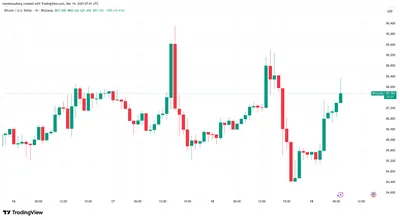
Arthur Hayes, co-founder of BitMEX, presents a specific scenario for Bitcoin's price movement: initially recovering to around $124,000, followed by a potential surge to $200,000. This is not a simple price prediction — Hayes connects this trajectory to the Federal Reserve's actions and how the market perceives them. A key element in his reasoning is the bond reinvestment program (RMP), which he estimates systematically adds liquidity to the financial system.
Arthur Hayes' Bitcoin Price Forecast
Hayes outlines a two-stage path: first a "recovery" to about $124,000, then a possible leap to $200,000 under certain conditions. The main idea is that Fed policy could create an environment where additional cash flows support risky and high-yield assets, including Bitcoin. However, the forecast is conditional: it only holds if the mechanisms Hayes relies on remain in place.
Impact of Fed Policy on Bitcoin Price
At the core of Hayes' argument is the reinvestment program (RMP), which he notes adds roughly $40 billion in liquidity to the system each month. The crucial question is whether the market will interpret these inflows as a form of quantitative easing (QE); according to Hayes, this perception could catalyze growth. Similar links between monetary policy and crypto prices are discussed in other forecasts, such as the Citibank Forecast, which also analyzes macro factors.
Timeframe for Bitcoin's Growth
Hayes does not promise an immediate "takeoff": he expects a consolidation period before significant growth. This phased development reflects his thesis that the market needs time to shift its perception of the Fed's current actions and assign them a stimulative status. Different scenarios and timing estimates can be compared in the piece on the 2026 Forecast, which explores alternative trajectories.
Risks to the Optimistic Forecast
The main risk to Hayes' model is a Fed policy reversal: if liquidity injections stop or are wound down, the forecast loses its foundation. He explicitly states that his entire hypothesis depends on the continuation of the current program and on how responsible parties act — the text discusses the role of New York Fed leadership and market reactions to their statements. Consequently, any unexpected change in central bank policy could significantly alter the price trajectory.
Why This Matters
For miners, Bitcoin price changes affect revenue from coin sales and the overall value of mining assets, so understanding price drivers remains a practical decision-making tool. Even if your mining operation is small, news about Fed policy and liquidity volumes helps assess the likelihood of periods with increased volatility or sustained BTC demand.
Additionally, the risk of policy reversal means high-growth scenarios depend not only on internal market dynamics but also on external political decisions. This requires attention to news and evaluation of how the market’s interpretation of Fed actions evolves over time.
What to Do?
- Monitor Fed statements and media coverage of RMP — this will help spot shifts in market perception promptly.
- Track your mining cost basis and regularly review margins: knowing current expenses eases decision-making during volatile periods.
- Develop action plans for different scenarios (consolidation, growth, policy reversal) and predefine triggers for selling or accumulating coins.
- Don’t rely solely on one forecast: cross-check with alternative assessments and market reviews.
Frequently Asked Questions
What is RMP and why is it important? RMP is the Fed’s bond reinvestment program that adds liquidity to the system; according to Hayes, how the market perceives it can influence capital flows into risky assets, including Bitcoin. This interpretation underpins his forecast.
Does continuation of RMP guarantee growth to $200,000? No — Hayes emphasizes growth is only possible if the market views RMP as a stimulus similar to QE; the program’s existence alone is just one part of the hypothesis.