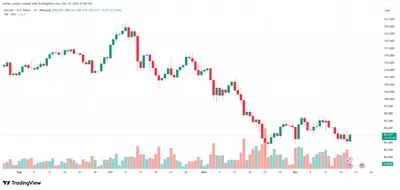
The total stablecoin market volume as of December 20, 2025, is $309.294 billion, with $823.09 million exiting the sector over the past seven days — a decrease of 0.27%. The week resembled more of a pause: the top positions remained stable, while mid-tier issuers shifted places amid capital redistribution.
Stablecoin Market Overview
According to market data, the total capitalization holds just below the $310 billion mark, standing at $309.294 billion at the time of this report. The weekly decrease of $823.09 million reflects not a mass capital outflow from the crypto ecosystem but rather a redistribution of funds among issuers and products.
Leaders and Laggards of the Week
Tether (USDT) remains the undisputed leader by capitalization: its volume is $186.288 billion, representing 60.23% of the total market. Market attention was also drawn to movements around USDT; see the article on USDT transfers for details on major transactions.
Circle’s USDC lost 1.67% of its capitalization — a reduction of $1.311 billion. Meanwhile, Sky (formerly MakerDAO) and its USDS gained 1.11%, equivalent to an inflow of $71.47 million, while Ethena’s USDe decreased by 1.41%, losing $91.91 million.
Paypal’s PYUSD showed a slight increase of 0.22% with an inflow of $8.66 million, whereas World Liberty Financial’s USD1 rose by 0.16%, gaining about $4.4 million. Among other mid-tier players attracting capital were Circle’s USDY, which grew by 5.09%, bringing its capitalization to $1.415 billion after an inflow of $68.53 million, and Ripple’s RLUSD, which increased by 3.21% or $42.2 million, reaching a valuation of $1.359 billion.
Some issuers experienced notable outflows: Blackrock’s BUIDL declined by 6.22%, losing $82.16 million and dropping to a capitalization of $1.239 billion. Regarding BlackRock’s products, see also the material on outflows from BlackRock products to better understand the scale of these movements.
Stablecoin Market Dynamics
This week saw capital redistribution among issuers: large positions remained stable, while the middle of the table regularly changed composition. Different issuances reacted differently — some tokens received inflows, others outflows, indicating selective reassessment of risks and opportunities within the sector.
Special attention should be paid to tokens backed by treasury instruments: their dynamics were mixed and depended on the specific issuer and circumstances surrounding the project. As a result, the market overall remained steady, but several issuers stand out as assets with momentum.
Conclusions and Forecasts
The week’s outcome can be characterized as a "standing" market with localized capital movements: the overall picture did not undergo fundamental changes, but sorting of issuers by demand is underway within the rankings. The top remained unchanged, while significant shifts occurred in the mid-segment.
To assess market conditions, it is important to monitor not only total capitalization but also the direction of inflows and outflows among key issuers, as they determine liquidity availability and spot market behavior in the short term.
Why This Matters
If you mine in Russia with a small or medium setup, stablecoin market behavior affects the speed and cost of withdrawing income to fiat and the stability of trading pairs. During capital redistribution among issuers, liquidity may temporarily decrease for some while increasing for others, impacting spreads and fees during conversion.
Even if changes in the stablecoin market do not directly affect your devices’ operation, they can influence the conditions for exchanging proceeds into rubles or dollars and the availability of fast-growing or revolving channels for fund withdrawals.
What to Do?
- Monitor key indicators: total capitalization and major inflows/outflows in USDT and USDC are liquidity indicators.
- Don’t keep everything in one stablecoin: if necessary, distribute proceeds among several trusted issuers to reduce the risk of localized illiquidity.
- Plan withdrawals: for large transfers and market volatility, choose longer conversion windows to avoid unfavorable spreads.
- Maintain reserves in fiat or on exchanges with proven liquidity to respond promptly to demand spikes or drops in availability of specific stablecoins.