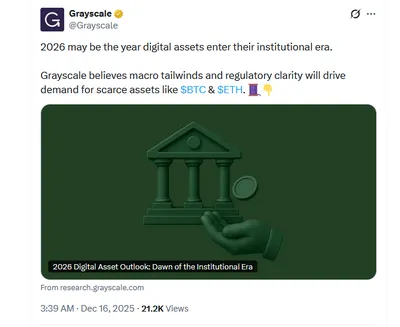
Grayscale forecasts that the tokenized asset market could increase approximately 1,000 times by 2030. In this article, we explain what tokenized assets are, assess the current market share, and list the technological and regulatory factors that Grayscale believes could accelerate growth.
What Are Tokenized Assets?
Tokenized assets are real financial instruments and items (stocks, bonds, real estate, commodities) represented digitally on a blockchain. Such a token acts as a digital proof of ownership or share and can facilitate trading and fractional ownership. According to Grayscale, tokenized real assets currently account for only about 0.01% of global stock and bond markets, highlighting significant untapped potential.
Grayscale’s Forecast: 1000x Market Growth by 2030
Grayscale cites a potential market growth of approximately 1,000 times by the end of the decade, linking this opportunity to fundamental changes in how value is represented and transferred. The firm emphasizes that this shift does not mean replacing traditional finance but adding an additional layer for more transparent and accessible asset trading.
Grayscale identifies two main groups of growth drivers: the development of blockchain infrastructure and the emergence of clear regulatory frameworks. If these conditions are met, infrastructure and regulations could pave the way for large-scale migration of traditional assets onto blockchains.
Which Blockchains Will Benefit from Tokenized Asset Growth?
In its analysis, Grayscale highlights several networks that could potentially benefit from the rise of tokenization: Ethereum (ETH), BNB Chain (BNB), Solana (SOL), and Avalanche (AVAX). Each of these platforms offers features useful for tokenization, such as security, scalability, or specialized solutions.
Beyond the networks themselves, Grayscale notes the role of middleware protocols: for example, Chainlink (LINK) is mentioned as a key middleware that connects blockchains with external data, making tokenized representations of real assets practical and reliable.
Advantages and Challenges of Tokenized Assets
Tokenization promises to enhance the efficiency and accessibility of financial markets, simplify fractional ownership, and speed up settlements. These benefits make tokenization attractive to both retail and institutional participants.
- Improved clearing and settlement efficiency.
- Access to fractional shares of assets (real estate, bonds, etc.).
- Simplified cross-border trading and increased liquidity.
At the same time, Grayscale points out significant obstacles: lack of unified regulatory standards, cybersecurity concerns, and the challenge of integrating with existing financial systems. Addressing these issues is crucial to achieving the projected market scale.
How to Invest in Tokenized Assets?
Currently, access to tokenized assets is mostly available through specialized platforms and cryptocurrency exchanges that offer tokenized products. As the market grows, more traditional access methods, including exchange-traded products, will emerge.
- Research platforms and exchanges offering tokenized products and verify their legal structures.
- Evaluate platform security, key storage, and token audit mechanisms.
- Monitor products on traditional venues and exchanges, including the emergence of new ETPs.
For broader context, you can check materials on crypto investment trends, as well as the connections between tokenized assets and Bitcoin forecasts in the article on tokenized assets and Bitcoin. Information on the growing number of exchange-traded products is available in the review about crypto ETPs.
Why Does This Matter?
If you mine and live in Russia, the direct connection between tokenization of real assets and your routine mining may not always be obvious, but the growth of this market impacts the overall load and demand on blockchain ecosystems. As new tokenized products emerge, the importance of the networks and infrastructure mentioned by Grayscale increases, which may affect activity on the respective chains.
Moreover, the development of clear regulatory frameworks and infrastructure—factors Grayscale names as key—creates a more predictable environment for services and platforms where additional services and products related to real asset tokens may appear.
What Should You Do?
For miners with 1–1000 devices, it makes sense to monitor several directions and prepare infrastructure for possible ecosystem changes. Primarily, focus on the technical reliability and security of your equipment and wallets, as well as updates to node and miner software.
- Regularly update firmware and software, monitor backups and key protection.
- Follow developments in Ethereum, BNB Chain, Solana, and Avalanche—named by Grayscale as key networks.
- Keep an eye on regulatory news and products on local platforms to assess new monetization opportunities.
- Study middleware protocols like Chainlink if you plan to interact with services tied to real-world data.
FAQ
What does "tokenized asset" mean? A tokenized asset is a real asset (stock, bond, real estate, or commodity) represented as a digital token on a blockchain, which confirms ownership rights and simplifies trading.
Why does Grayscale predict 1000x growth? They estimate the current share of tokenized real assets in the global stock and bond markets at about 0.01%, and with infrastructure and regulatory development, the market could expand sharply.
Which networks will benefit the most? Grayscale highlights Ethereum, BNB Chain, Solana, and Avalanche as primary beneficiaries of tokenization, with Chainlink as an important middleware connecting real-world data.
Is investing in tokenized assets risky? Like any new financial instruments, tokenized assets carry risks, including regulatory uncertainties and technical vulnerabilities, so it's important to conduct your own research and assess platform security.
How can an average person invest in tokenized assets? Currently, access is mostly through specialized platforms and crypto exchanges; as the market grows, more traditional access tools will appear.