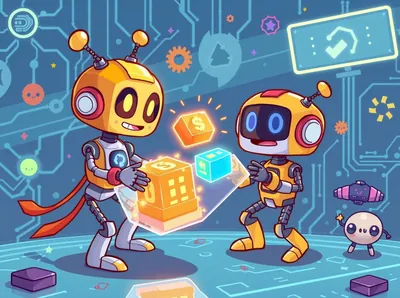
John Wang, head of Neo ecosystem growth and managing director of Neo Ecofund, frames a near‑term evolution in blockchain: the Sentient Economy, where AI agents act as autonomous economic participants. He presents Spoonos, Neo’s new framework for AI agents, as technical scaffolding that supports a developer runtime and a unified data layer. Wang highlights collaborations with projects such as ChainGPT and Morph and pointed to developer activity at the Scoop AI Global Hackathon, which saw over 500 developers across Silicon Valley and London.
Introduction to the Sentient Economy
The Sentient Economy is described as an economic system in which AI agents—rather than only human operators—can own assets, make autonomous decisions, and interact trustlessly on‑chain. This idea advances beyond the earlier “Smart Economy” focus on programmable assets, emphasizing agents that can perceive and reason as participants. According to Wang, the shift is about enabling agents to be verifiable, accountable and composable within blockchain infrastructure.
John Wang's Vision
Wang sees integration of AI and blockchain not as two parallel trends but as the foundation for a new class of economic actors. He frames these agents as sovereign entities that can prove identity, execute transactions without human intermediaries, and remain accountable through transparent on‑chain code. For Wang, this combination repositions blockchain as a coordination substrate for autonomous, silicon‑native agents rather than solely a ledger for tokens and consensus.
Spoonos: The Framework for AI Agents
Spoonos is presented as Neo’s successor to its Smart Economy philosophy and as the practical tooling for building on‑chain agents. The framework currently supports a developer runtime and a unified data layer, enabling agents to reason using AI models while acting via blockchain execution. Through strategic collaborations with industry projects such as ChainGPT and Morph, Neo aims to cultivate an ecosystem where agents can interoperate across platforms and protocols.
Challenges and Future Prospects
Wang acknowledges key hurdles remain before the Sentient Economy is broadly realized. Developer tooling is still early: connecting high‑level AI reasoning to low‑level blockchain execution requires more mature kits, and mechanisms for autonomous value capture by agents are nascent. Additionally, the learning curve for developers is steep because building these agents sits at the intersection of AI, blockchain, and decentralized coordination.
The Civilizational Shift
Wang describes the movement as a civilizational transformation from programmable value to programmable intelligence, where blockchain gives AI the cryptographic keys to reason, transact and persist on‑chain. He argues this alters the role of blockchain from a transaction layer to a substrate that coordinates autonomous actors and hybrid intelligences. In Wang’s view, embedding agency on‑chain opens a new mode of interacting with digital and physical systems.
Why this matters
For a miner operating in Russia with anywhere from one to a thousand devices, the immediate technical impact may be limited: the story focuses on agent architecture and developer tooling rather than mining hardware or consensus changes. Nevertheless, the broader shift could influence the software and services that interact with blockchains, affecting demand for on‑chain computation and new coordination layers. Keeping an eye on frameworks like Spoonos and ecosystem collaborations helps understand where developer effort and integrations are heading.
What to do?
- Follow tooling developments: track updates to Spoonos and related projects to see which integrations matter for transaction types you may serve.
- Mind security and keys: as agents gain on‑chain capabilities, practices around key management and transaction authorization remain critical for miners and node operators.
- Learn basic interoperability concepts: understanding how agents interact on‑chain helps anticipate changes in transaction patterns and service demand.
- Monitor ecosystem partners: collaborations such as those with ChainGPT and Morph indicate which platforms may drive early agent usage and integrations.
For broader context on how cryptocurrency can reshape finance and privacy, see how crypto will change finance. For background on blockchain as infrastructure for decentralized finance, consult what is DeFi.
FAQ
What is the Sentient Economy? The Sentient Economy is a blockchain‑based system where AI agents act as sovereign economic participants, able to own assets and make autonomous on‑chain decisions.
Why did Neo launch Spoonos? Neo introduced Spoonos to provide the framework and technical scaffolding for building and coordinating autonomous AI agents on‑chain, positioning it as the successor to the Smart Economy philosophy.
How does this differ from the Smart Economy? The Smart Economy emphasized programmable assets and automated contracts, while the Sentient Economy aims to enable programmable intelligence—agents that perceive, reason and act on‑chain.
Where is adoption happening first? Wang highlighted developer activity and collaborations across hubs including Silicon Valley and London, and noted the Scoop AI Global Hackathon involved over 500 developers in those locations.