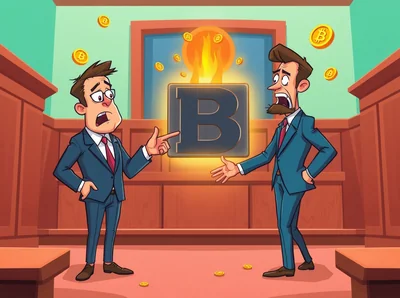
The bankruptcy administrator in the Terraform Labs case, Todd Snyder, has filed a lawsuit against Jump Trading and two of its executives seeking $4 billion in damages. According to the Wall Street Journal, the complaint accuses the firm of extracting billion‑dollar gains and of actions that allegedly contributed to Terraform Labs’ $40 billion collapse.
Quick overview of the suit against Jump Trading
The plaintiff is Todd Snyder — the court‑appointed administrator tasked with liquidating the remaining assets of the Terraform Labs ecosystem. The defendants named are the trading firm itself, its co‑founder William DiSomma, and Kanav Kareya, who the filing says rose from intern to platform president.
The complaint seeks $4 billion in damages and alleges that Jump Trading entered into secret agreements to support the UST peg and realized substantial profits as the collapse unfolded. The filing was confirmed by the Terraform Labs account on X, which referenced the WSJ report.
Main allegations, quotes and wording from the complaint
Snyder explicitly accuses Jump Trading of “manipulation, concealment, and self‑dealing,” stating: “Jump Trading actively exploited the Terraform Labs ecosystem through manipulation, concealment, and self-dealing that enriched Jump while financially devastating thousands of unsuspecting investors.” These formulations are taken from the Wall Street Journal report and are reflected in the complaint.
The document also refers to an alleged “secret agreement” to support TerraUSD (UST) prior to the loss of its peg and claims the trading firm emerged from the collapse with billion‑dollar gains. Earlier SEC materials cited roughly $1 billion that Jump earned from selling the Luna token.
Timeline of the Terraform Labs collapse
The Terraform Labs collapse occurred in 2022 after the algorithmic stablecoin TerraUSD (UST) lost its peg to the dollar. Over the course of a few days, the companion token Luna fell to almost zero, triggering a sharp market crash and financial losses for a large number of investors.
The implosion was estimated at $40 billion and, according to filings, resulted in the loss of savings for hundreds of thousands of people and further industry fallout that culminated in the later collapse of the FTX exchange in the same period.
Financial scale and prior settlements
The company, based in Singapore, filed for bankruptcy in January 2024 and subsequently agreed to pay roughly $4.5 billion as part of a settlement with the U.S. Securities and Exchange Commission (SEC). Those settlements reflect the scale of claims and consequences for participants in the ecosystem.
The suit against Jump Trading adds another major financial dispute to the chain of litigation tied to the Terra collapse and suggests that some market participants may have profited significantly during the price decline.
Key figures and their roles
Todd Snyder is serving as the court administrator, overseeing the liquidation of Terraform Labs’ assets and protecting the interests of creditors and harmed investors. The project’s founder, Do Kwon, launched the company in 2018, later pleaded guilty, and according to filings was sentenced to 15 years in prison.
Among the defendants are Jump Trading co‑founder William DiSomma and Kanav Kareya, whose trajectory at the firm is described as rising from intern to platform president. More on Do Kwon’s sentence can be read in the piece Do Kwon sentenced to 15 years, and confirmation of the lawsuit filing is collected in a separate note filed a $4B lawsuit.
Legal context and next steps
The suit was filed in the U.S. District Court for the Northern District of Illinois, where objections, motions and evidentiary matters will be considered. The plaintiffs seek to recover damages and hold the defendants accountable for the alleged unlawful conduct set out in the complaint.
Alongside these proceedings, the industry is watching related litigation and regulatory settlements; this is also reflected in other initiatives to increase oversight of crypto assets, such as discussions around legislative measures. One related piece on legislative efforts is available at SAFE law.
Why this matters
For a miner in Russia operating 1–1,000 devices, this action alone will not shut down equipment or change the farm’s operations, but it underscores that legal proceedings arising from major collapses continue and may target market participants who, according to the plaintiff, profited during the crash. That affects the broader legal climate in the industry and the potential availability of compensation for harmed investors.
Moreover, the suit signals administrators’ and regulators’ attention to the conduct of large trading firms and their role in market events. Even if there are no direct economic consequences for a small farm, miners should follow the outcomes of such cases because they create precedents and practices for recovering losses in the industry.
What to do?
- Monitor official sources: check court filings and the administrator’s publications (for example, confirmations on X and WSJ materials) rather than relying on rumors.
- Keep transaction records: save logs, statements and records of token transfers that may be needed when filing for compensation or for tax purposes.
- Assess asset risks: avoid keeping large sums on exchanges and centralized services unless necessary, and diversify holdings across instruments to reduce risk.
- If you were harmed as an investor, review the procedures for filing claims in the bankruptcy process and follow the administrator’s information on how to submit compensation claims.
Frequently asked questions
Who filed the suit and against whom?
The suit was filed by Todd Snyder, the court administrator for Terraform Labs. The defendants named are Jump Trading, its co‑founder William DiSomma, and Kanav Kareya.
How much is the plaintiff seeking?
The complaint seeks $4 billion in damages.
Did Terraform confirm the WSJ report?
Yes — the Wall Street Journal report was confirmed via the “Terraform Labs Post-Chapter 11” account on X.