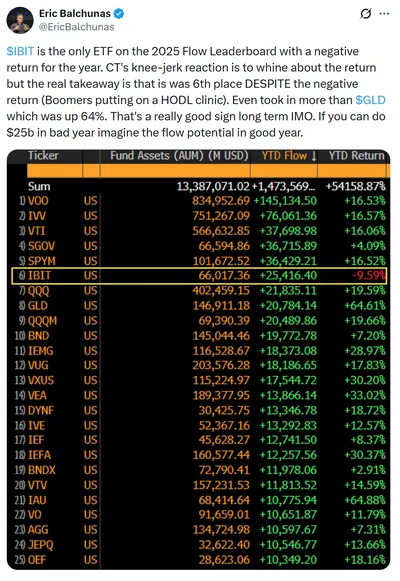
BlackRock’s iShares Bitcoin Trust (IBIT) drew roughly $25 billion of net inflows in 2025 even though the fund posted negative annual returns. This level of capital placed IBIT sixth among all ETFs for money raised, a notable achievement given its yearly loss.
BlackRock’s IBIT Bitcoin ETF Achieves Remarkable Inflows
The scale and persistence of IBIT’s inflows stand out against the broader ETF universe. Below are the core facts about this development:
- IBIT attracted approximately $25 billion in net inflows in 2025 despite negative returns.
- The fund secured the sixth position among all ETFs for capital attraction.
- It is the only fund among the top ETFs to maintain powerful inflows while in the red for the year.
Why Is IBIT So Resilient?
Bloomberg ETF analyst Eric Balchunas highlighted IBIT’s unusual performance and called the pattern a “very positive long-term signal.” His observation focuses on sustained buying even during a down year, which suggests some investors are treating the fund as a strategic holding rather than a short-term trade. This behaviour fits into broader reports on spot Bitcoin ETF demand, including related coverage of Spot Bitcoin ETFs inflows that track capital movement into the space.
Why Isn’t Bitcoin’s Price Reacting More Strongly?
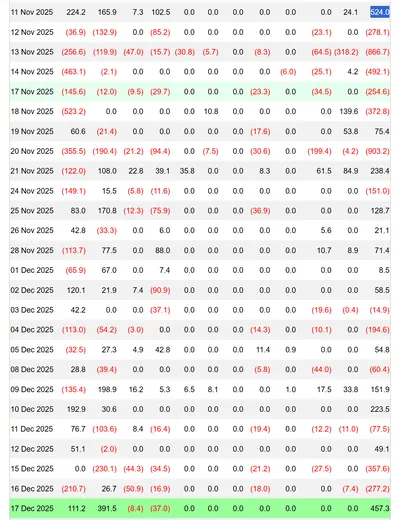
Observers have noted that large ETF inflows do not always translate into immediate price spikes, and commentators point to signs of market maturation as an explanation. The inflows into IBIT have been described as “sticky” capital that institutional buyers are likely to hold through cycles, which can blunt short-term price reactions and support a more stable base for the asset. Coverage that also records shorter-term outflows, such as reports on IBIT outflows, illustrates how flows can vary even as the overall picture shows large net accumulation.
Long-Term Signal for Bitcoin ETF Adoption
IBIT’s ability to attract large sums during a down year shifts the narrative from speculative trading toward strategic allocation by big investors. That $25 billion figure is more than a headline number: in context it signals that some institutional participants view Bitcoin through a long-term lens and are building positions accordingly. Such behaviour aligns ETF allocation with how institutions accumulate other foundational assets rather than treating Bitcoin as a purely tactical bet.
Why this matters (for a miner in Russia)
For a miner operating from a single rig up to a modest farm of 1,000 devices, this news does not change day-to-day operations or electricity and maintenance needs. At the same time, large institutional inflows into a widely traded ETF are a sign that capital is accumulating in Bitcoin via regulated channels, which can affect market depth and the range of counterparties miners interact with when selling coins.
What to do? (practical steps for miners)
- Monitor capital flows, not only spot price: track ETF inflows as one of several indicators of institutional demand and market stability.
- Revisit cash-flow plans: consider whether to sell mined coins immediately or hold part of production if you expect longer-term institutional accumulation to support higher price floors over time.
- Keep operating costs under control: institutional maturity does not remove operational risks, so focus on uptime, efficiency and cost per hash to remain resilient.
Conclusion
IBIT’s $25 billion inflow during a year with negative returns is an uncommon outcome that underlines growing institutional engagement with Bitcoin via ETFs. While it may not produce an instant price rally, the pattern is a signal that some large investors are treating Bitcoin as a long-term allocation, which matters for market structure and for miners deciding how to manage mine-and-sell strategies.