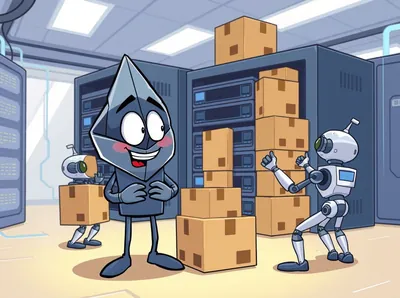
The Ethereum core team has officially named the network’s coordinated upgrade for the second half of 2026: the Hegota upgrade. The upgrade combines execution- and consensus-layer changes with the stated goal of substantially reducing the operational burden on network participants and preparing the protocol for next-generation client software.
Quick summary: what Hegota is and when it’s expected
Hegota is a single name for a coordinated set of protocol changes targeted for the second half of 2026. Its two primary purposes are to implement Verkle Trees and introduce a state expiry mechanism, both intended to shrink the active state nodes must handle and to enable more lightweight client architectures.
Why the name "Hegota" matters
The name blends two planned upgrades: 'Bogota' for the execution layer and 'Heze' for the consensus layer, signalling a coordinated effort across both parts of Ethereum’s stack. Coordinating changes at both layers matters because some improvements require simultaneous updates to execution and consensus logic to work correctly and safely.
The core problems Hegota addresses
Ethereum currently faces growing resource demands from the chain’s accumulated state, a problem commonly called 'state bloat.' As the active state grows, running a full node becomes more resource-intensive, which can push smaller operators out and increase centralization risks. Hegota targets these problems directly by adding mechanisms that reduce what full nodes must keep in active storage.
Key technical features: Verkle Trees and state expiry
Hegota’s two headline features are Verkle Trees and a state expiry mechanism, which together create the conditions for stateless clients. Verkle Trees allow for much smaller cryptographic proofs of state, so clients can verify transactions without storing the entire chain state; this reduces syncing time and hardware needs for participants.
- Verkle Trees: enable compact proofs that reduce storage and bandwidth requirements for verifying state.
- State expiry: archives old or inactive data from the blockchain’s active state to prevent indefinite growth of what nodes must store.
- Stateless clients: these depend on the above features to verify the chain with minimal local storage, lowering the barrier to run a client.
Impact for users, developers and validators
For node operators, the most immediate benefits are faster syncs and reduced hardware requirements, since Verkle Trees and state expiry shrink the amount of active data. For developers and services, these changes can lower infrastructure costs and change assumptions about how much state a backend must hold, which may affect indexing and caching strategies.
For validators and staking infrastructure, the upgrade requires careful coordination because it is implemented as a scheduled hard fork and all node operators must update client software. Some service providers and infrastructure teams will also need to adapt monitoring and tooling to the new state management model; see this note on why leaders choose Ethereum for related context in ecosystem choices.
Implementation timeline, risks and upgrade mechanics
Hegota is planned as a scheduled hard fork, which means node operators will be required to install compatible client releases before activation. The stated 2026 target is a goal that could shift if implementation complexity, testing outcomes, or community consensus demand more time.
The published two-year timeline reflects the significance and complexity of these protocol changes, and developers will run extensive testing and coordination to ensure backward-compatibility and network safety. Because of that, careful upgrade orchestration and clear release notes will be essential for a smooth transition.
How node operators and projects should prepare
Operators and projects should track client releases and participate in testnets and public test vectors as they become available. Testing client upgrades in a controlled environment, updating monitoring, and validating backups are practical steps to reduce risk during the hard fork window.
For validators and those running staking infrastructure, it’s important to follow client maintainers’ upgrade instructions and to rehearse the update process on non-production environments. Services that depend on state may also need to adjust data retention and archival strategies and to verify compatibility with the new state model; infrastructure teams can watch developments such as the recent staking deposit discussions for operational implications.
Why this matters for miners and small-scale operators in Russia
If you run mining gear or a small node farm in Russia, Hegota’s goals are relevant even if you don’t host large infrastructure. Lower node storage and faster syncs can reduce electricity and hardware costs for operators who also maintain a node alongside mining hardware. At the same time, the requirement to update clients at a scheduled hard fork means planning maintenance windows and ensuring software sources are trusted.
Even miners with a handful of devices benefit from the broader aim of preserving decentralization: fewer resource barriers to run a node make it easier for independent operators to participate in the network. Still, because the upgrade is significant, prepare to allocate time for updates and testing rather than expecting a seamless, automatic transition.
What to do: concise checklist for node operators and miners
- Subscribe to official client release channels and release notes to get update timelines and instructions.
- Test client upgrades on testnets or isolated machines before updating production nodes.
- Verify backups and recovery procedures for node data and keys, and ensure secure access to update tooling.
- Schedule maintenance windows around the hard fork and communicate any planned downtime to service users.
- Update monitoring and alerting to catch issues introduced by the new state management model.
Short FAQ
When is Hegota scheduled? The upgrade is targeted for the second half of 2026 as a goal, but that timeline can change depending on implementation complexity, test results, and community agreement.
Will Hegota be a hard fork? Yes. It will be implemented via a scheduled hard fork, and all node operators will need to update their client software to remain compatible.
What are Hegota’s main features? The upgrade’s principal features are Verkle Trees and a state expiry mechanism; together they enable the prerequisites for stateless clients and aim to reduce the active state that nodes must store.